Synopsis
After an accident, identifying frame and unibody damage requires more than a visual check. At Auto Collision Center of Exeter, each step of the collision repair process uncovers damage that no walk-around inspection can find.
Key Takeaways
- Frame and unibody are two different structures; collision forces affect each differently
- Visual assessment alone cannot detect structural shifts measured in millimeters
- Electronic pre-scanning identifies hidden fault codes before any panel is removed
- Laser frame measuring confirms whether structural geometry meets factory specifications
- The identification process produces a documented repair scope before any work on your vehicle is authorized
After an accident, your first instinct is probably to walk around your vehicle and look at the damage. That is a natural reaction. But when it comes to frame and unibody damage, what you see on the outside rarely tells the full story.
The structural damage your vehicle may have sustained does not stay at the point of impact. Collision forces travel through the welded structure and displace reference points far from where your car was hit. A rear impact can shift a front mounting point. A front collision can alter firewall geometry. Your exterior may show nothing more than a scuffed bumper cover.
That is why at Auto Collision Center of Exeter, we follow a specific sequence of tools and methods to find what the surface cannot show. Knowing that process helps you ask the right questions after any accident, minor or major.
Frame Damage vs. Unibody Damage: What Is the Difference?
Before we identify damage in your vehicle for auto collision repair, it helps to know what we are measuring. Frame and unibody are two distinct structural designs, and collision forces affect each one differently.
Body-on-Frame Construction
Body-on-frame vehicles use a separate steel ladder chassis beneath the body. Larger trucks and full-size SUVs are typically built this way. When your truck or SUV sustains frame damage, the chassis itself has bent, twisted, or cracked. The damage zone usually stays closer to the impact area. Severe collisions, however, can affect the full length of your frame.
Unibody Construction
Unibody vehicles integrate the body and frame into one continuous welded assembly. Most late-model passenger cars, crossovers, and smaller SUVs use this design, including the vehicles we work on most often. Crumple zones are built into specific sections of your vehicle: front rails, rear rails, and rocker panels. These sections absorb collision energy in a controlled sequence.
The challenge with your unibody vehicle is that force distribution is widespread. A front rail impact can displace a firewall mounting point far from where you were hit. That is why we measure the entire assembly, not just the impact zone.
Why a Visual Check Cannot Detect Structural Damage in Your Vehicle
Structural shifts in your unibody vehicle are measured in millimeters. A 3mm displacement at a suspension mounting point changes your camber angle, alters caster geometry, and affects brake pull. These changes will not appear as a warning light on your dash. They show up gradually: uneven tire wear, a persistent pull to one side, or a steering wheel that sits off-center.
According to the Insurance Institute for Highway Safety (IIHS), major deformation or intrusion into the compartment is a good predictor of injury risk for people in similar crashes. The Institute evaluates the structural integrity of the occupant compartment, or safety cage, during the offset test and uses this as an important additional indicator of crashworthiness performance. Full restoration to factory tolerances is not optional. It is what keeps you safe.
Your exterior panels absorb visible impact energy. The structural damage is behind them. This is why our certified collision repair process starts with tools, not a walk-around.
The Diagnostic Tools We Use to Identify Frame and Unibody Damage
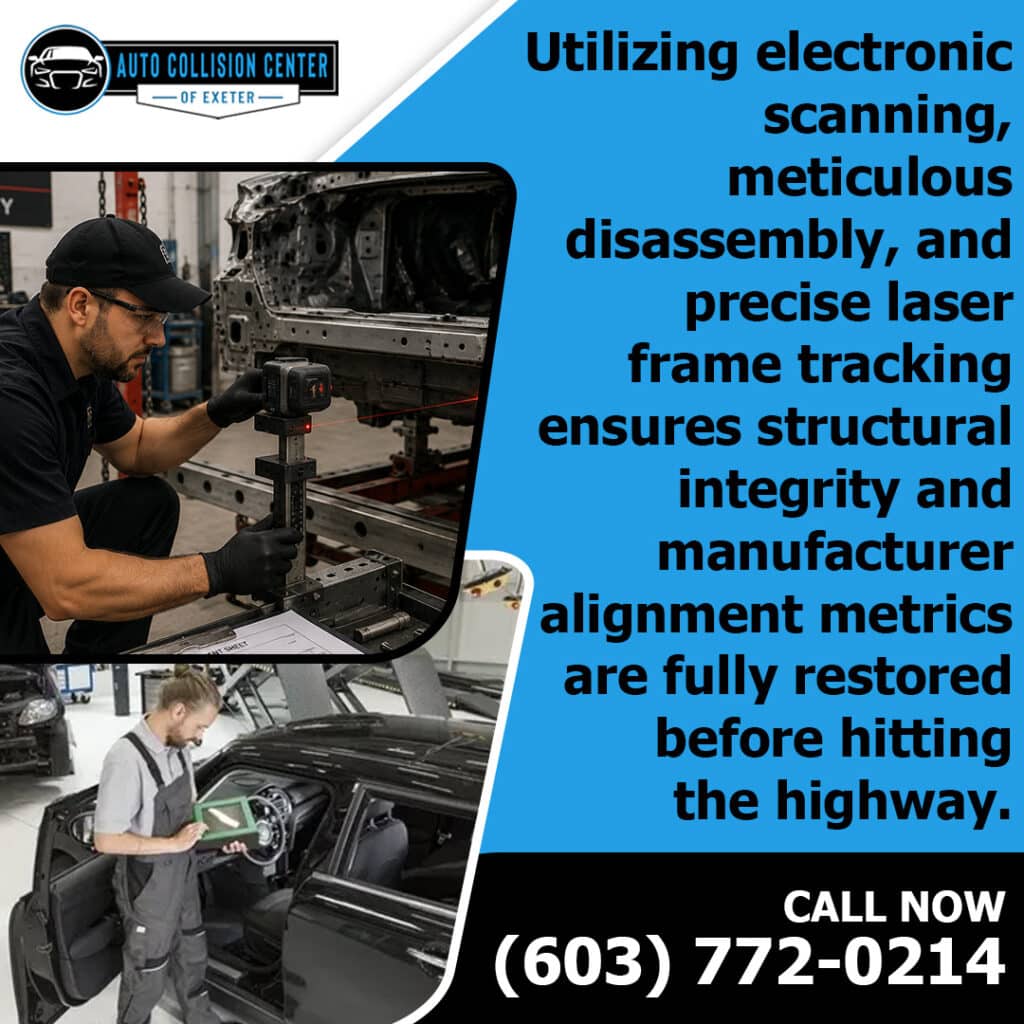
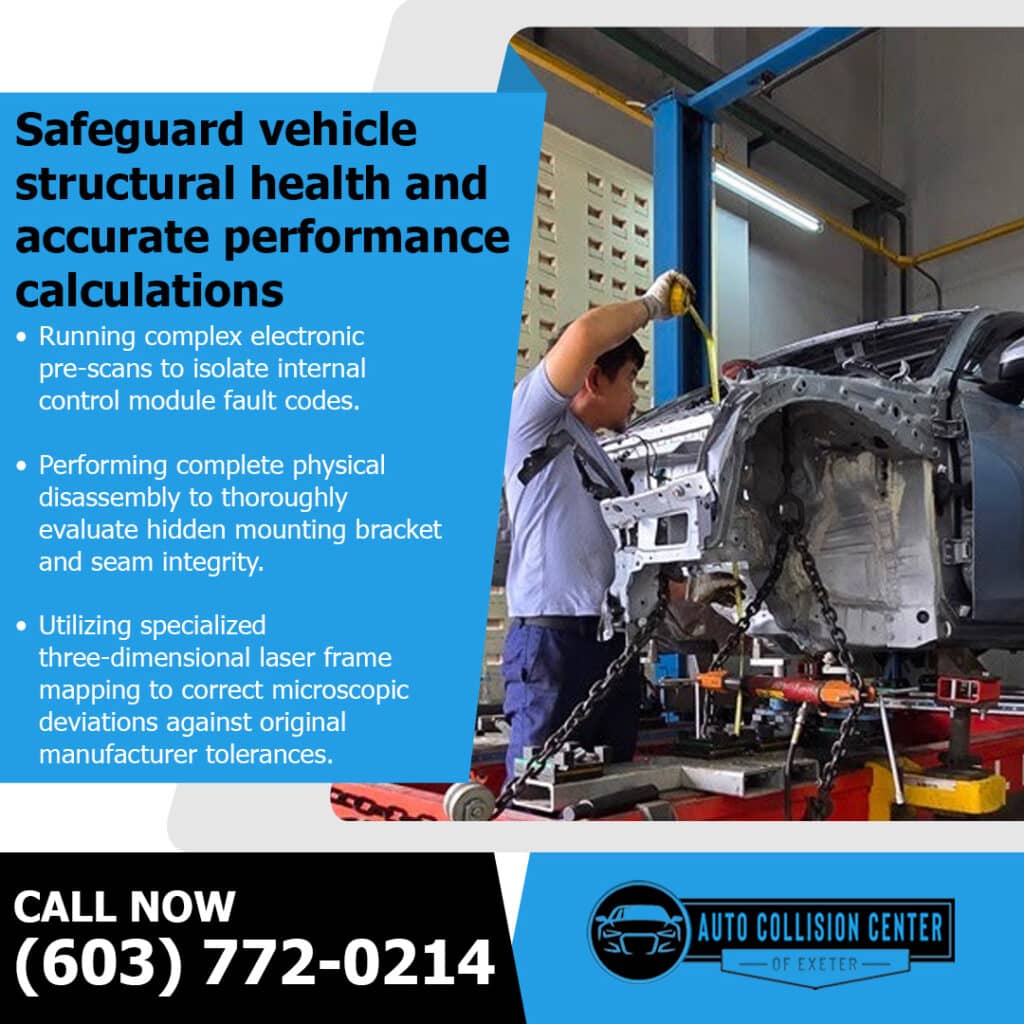
Accurately identifying structural damage in your vehicle requires three steps: electronic pre-scanning, physical disassembly, and laser frame measuring. At Auto Collision Center of Exeter, each step gives us information that the previous one cannot.
Electronic Pre-Scan Diagnostics
We run a pre-scan before any panel on your vehicle is touched. Our technicians connect Snap-On and Bosch diagnostic tools to your vehicle’s OBD system. They retrieve stored fault codes across all control modules. Those codes tell us which systems registered an event during your collision. This happens even when you see no warning lights on your dashboard.
Pre-scan results direct our structural inspection during disassembly. A fault code tied to a forward radar module tells us where to look first once we remove the panels. We only have that directional information if we run the scan before disassembly begins.
According to a 2022 study by the Partnership for Analytics Research in Traffic Safety (PARTS), released through MITRE, front crash prevention systems combining Forward Collision Warning and Automatic Emergency Braking reduce front-to-rear crash involvement by about 50 percent in real-world driving. Those systems in your vehicle depend on sensors that are undamaged and correctly positioned. Our pre-scan tells us whether any of them need attention after your collision.
One important note: our pre-scan identifies the need for ADAS recalibration in your vehicle. We coordinate that recalibration through our certified partners. It is not performed in-house at our facility.
Panel Removal and Physical Disassembly
Your exterior panels, covers, liners, and trim are designed to protect the structure beneath them, not to reveal its condition. What sits behind those panels matters most: impact absorbers, steel reinforcement members, bracket assemblies, and wiring routed through each zone.
A low-speed impact on your vehicle can fracture a reinforcement bar without leaving a visible mark on the panel face. The cover may look acceptable while the load-bearing component behind it has deformed. We have to remove it to know.
Once we have your panels off, we document what we find. We look for fractured reinforcement members, bracket deformation, and compressed or severed wiring. We also check for finish separation along seams where force entered your structure.
Laser Frame Measuring with Spanesi Equipment
Laser frame measuring tells us whether your vehicle’s structural geometry still meets factory specifications. Our Spanesi frame measuring system maps your vehicle’s structural reference points in three dimensions and compares each one against the manufacturer’s published tolerances for your specific make and model.
Those tolerances are tight, often within a few millimeters. Every reference point in your unibody structure is interconnected. We measure all of them simultaneously, because a single collision can produce deviations at multiple locations. A reading at your front rail that appears minor may show a meaningful deviation at a rear suspension point when we look at all measurements together.
The table below shows how structural issues in your vehicle translate into real safety consequences:
| Structural Issue | Safety Consequence |
| Frame misalignment | Airbag and crash sensor positioning may be affected; sensors require precise structural alignment to function as designed |
| Suspension misalignment | Wheels sit at incorrect angles, causing uneven tire wear and reduced traction |
| Asymmetric frame rails | Crumple zones cannot absorb impact as designed; crash energy distribution is disrupted |
| Steering geometry changes | Vehicle pulls to one side; emergency maneuvers become unpredictable |
| Brake force unevenness | Suspension or structural misalignment can affect vehicle stability during braking and may contribute to uneven tire loading or directional pull under hard braking |
Safety consequences reflect structural engineering principles documented by NHTSA and IIHS. Specific effects vary by vehicle make, model, and extent of damage.
If we skip this step, those deviations go undetected before your vehicle returns to the road.
What Our Identification Process Commonly Uncovers
After an accident, the gap between what you see and what you find can be significant. That gap is exactly why the full three-step identification process matters for your vehicle.
The most common finding that surprises vehicle owners is supplemental damage. An initial surface estimate captures visible impact damage. Our disassembly and frame measuring steps regularly reveal damage that was not part of that first assessment.
Common supplemental findings include:
- Reinforcement bars fractured behind intact exterior panels
- Mounting brackets bent under load and shifted from their original positions
- Wiring harnesses compressed or severed by structural movement
- Frame geometry deviations at points far from the impact zone
- Energy absorbers that have fully collapsed but left no visible mark on the panel face
Each of these findings changes the scope of your repair. Any one of them missed at the identification stage becomes a problem mid-repair. That means additional parts, delays, and costs added to your job.
What Our Identification Process Produces for You
The process we follow for auto collision repair in Exeter, NH process produces one documented output for your vehicle: a written repair scope. It records every confirmed structural finding and all supplemental damage identified after teardown. Required parts (OEM-preferred) and any ADAS recalibration needs are also included. We coordinate recalibration externally.
If you are filing an insurance claim, we submit the complete documentation on your behalf. Supplemental damage that was not visible in the initial estimate gets properly documented and submitted for insurer approval before any additional work begins. You do not have to manage that process yourself.
If you are paying out of pocket, the scope gives you a transparent picture of everything your vehicle needs. You review and approve the full scope before we start. Nothing is added without your knowledge.
Why Our Identification Process Affects Your Total Repair Cost
There is a direct relationship between thorough damage identification and what your car collision repair ultimately costs. Identifying damage early helps reduce the likelihood of repair delays, supplemental approvals, and unexpected workflow interruptions later in the repair process.
Shops that skip pre-scan or frame measuring often discover missed damage after repairs are already underway. At that point, your parts order changes, your insurer needs to re-approve, and your timeline extends. None of that adds value to your repair. It only adds cost and time.
Our I-CAR Gold Class certification requires that we follow documented OEM procedures for every repair we perform. That standard applies to the identification phase too, not just the repair work itself. Pre-scan and frame measurement are not optional steps in our certified collision repair process. They are how we protect the accuracy of your repair scope from the start.
When our identification is thorough, your estimate reflects what is actually needed. Your parts arrive correctly. Your repair proceeds without interruption. That is what makes affordable collision repair a product of process, not price shopping.
Frequently Asked Questions
Can I tell if my car has frame damage by how it drives?
Steering pull, off-center wheel position, and uneven tire wear can all indicate frame or unibody displacement in your vehicle. These symptoms often develop gradually after your collision, not immediately. The only reliable way to confirm whether your structure is within factory tolerances is a post-accident frame measurement.
Does my vehicle need frame measuring after every collision?
Any collision with enough force to damage exterior structural components on your vehicle warrants frame measurement. Low-speed impacts can shift your unibody geometry without leaving visible exterior damage. Measurement is not about the severity of your accident. It is about accuracy.
How does your identification process differ from a standard estimate?
A standard estimate covers what is visible from the outside of your vehicle. Our process goes further. We run a pre-scan to retrieve system fault codes. We remove exterior panels to inspect the structure beneath. We then use Spanesi laser frame measuring to verify every structural reference point against factory specifications. The resulting repair scope reflects your vehicle’s actual condition. That is the standard we hold our certified collision repair process to.
Schedule Your Damage Assessment at Auto Collision Center of Exeter
Your auto collision repair in Exeter, NH, at Auto Collision Center of Exeter starts with an accurate structural diagnosis. Whether your vehicle took a low-speed hit in a parking lot or sustained major collision damage, what you see on the outside is only part of the picture.
Our team brings fifty years of combined experience to every vehicle we work on. Bryan Dinger, our general manager, brings more than twenty years of collision repair experience to every repair we perform. His Universal Technical Institute training shapes how we approach each job. Our specialized tools find what a visual check misses.
Contact us at (603) 772-0214 or accofexeter@gmail.com to schedule your estimate. Our collision repair services in Exeter, NH, cover the full Seacoast region, including Portsmouth, North Hampton, and Stratham. Every accurate repair starts with an accurate diagnosis.