Synopsis
When your vehicle enters an auto body repair shop, it follows a structured process designed to restore safety, performance, and appearance. Each stage, from inspection to final testing, plays a role in identifying hidden damage and completing repairs correctly.
Key Takeaways
- Inspection and documentation establish an accurate starting point
- Diagnostic scans reveal hidden system and safety issues
- Disassembly exposes structural damage not visible initially
- Repairs follow OEM procedures to restore integrity
- Final checks and calibration confirm safe operation
When your car enters a professional auto body repair shop, it moves through a structured sequence. That includes inspection, diagnostic scanning, damage analysis, structural and body repairs, refinishing, and a final quality check. At Auto Collision Center of Exeter, we follow this process for every vehicle we take in. Knowing what each step involves helps you set realistic expectations and recognize quality work.
Why Understanding the Collision Repair Process Matters
Most drivers drop off a damaged vehicle without knowing what comes next.
Today’s vehicles are not simple machines. They contain sensor networks, advanced safety systems, and structural components that work together as a system. A collision can affect any of these, even when the damage looks minor from the outside. Car body repair is not just about restoring a vehicle’s appearance. It is about restoring how that vehicle was engineered to perform and protect you. As an I-CAR Gold Class-certified shop, our team approaches every repair with that standard. That level of detail is what separates standard repairs from our professional auto body repair, which drivers can rely on.
Understanding each step helps you identify a thorough shop from one that cuts corners. That distinction matters for auto body repair in Exeter, NH.
Step 1: Initial Check-In and Vehicle Inspection
What Happens When You First Arrive
Your first visit is a conversation. We confirm how the accident happened and what you have noticed since. We also clarify whether you are filing an insurance claim or paying out of pocket. If the vehicle is not safe to drive, we help coordinate towing to our facility.
Once your car arrives, we complete a formal check-in. We photograph the vehicle inside and out before any work begins to document its condition thoroughly. This documentation creates a complete record of the vehicle’s condition at the start. It protects your interests and gives our team a clear baseline for the entire repair.
Why Thorough Inspections Are Critical
Collisions frequently cause damage that does not show on the surface. A bumper cover may appear intact while the structure behind it is bent. A door may close without issue while the frame behind it has shifted.
Documenting everything from the beginning protects your interests with the insurance company. It gives our team an accurate starting point. Without a thorough inspection at intake, estimates are incomplete, and the repair becomes reactive rather than planned.
Step 2: Diagnostic Scanning and Damage Analysis
Pre-Repair Scanning for Hidden Issues
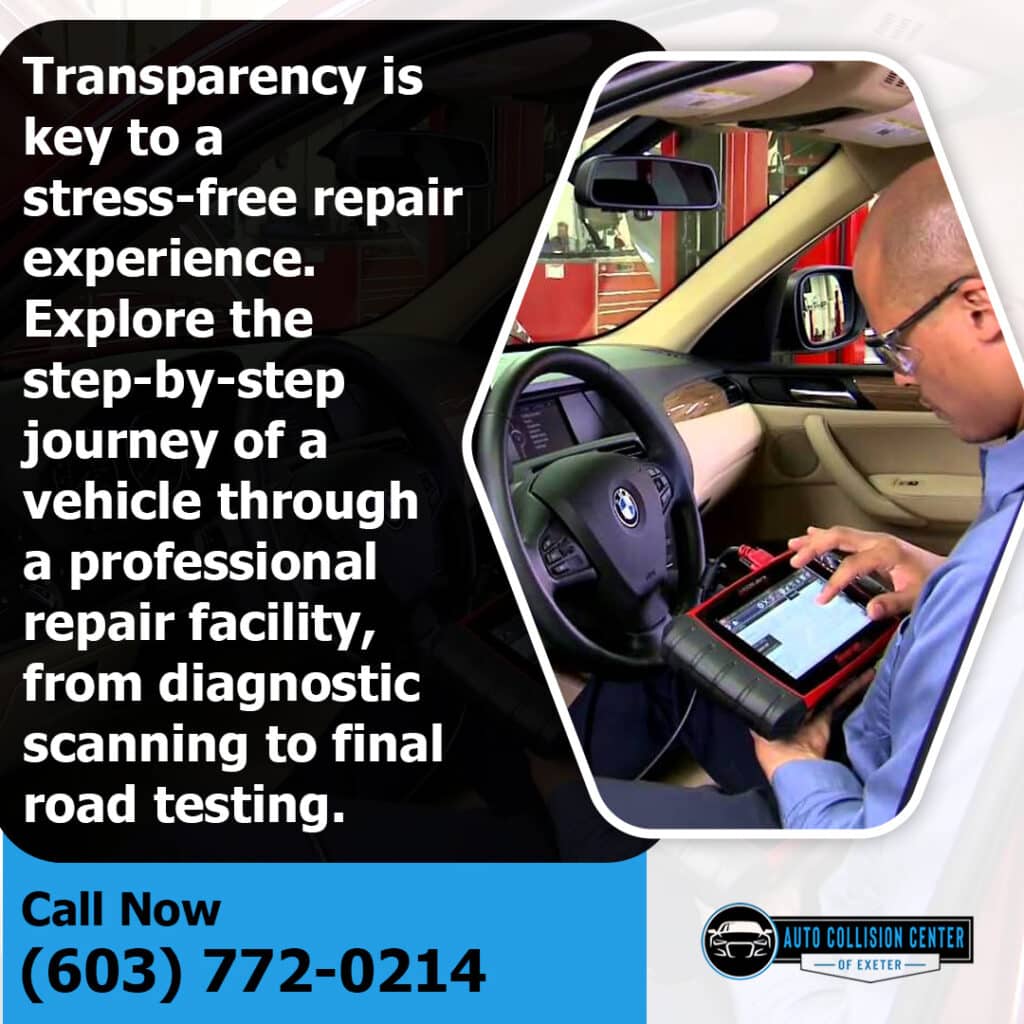
We run a pre-repair diagnostic scan using Snap-On and Bosch tools. This identifies active and stored fault codes across airbag systems, braking, blind spot monitoring, and other safety-related functions. It gives us a complete picture of how the collision affected the vehicle’s electronics. At Auto Collision Center of Exeter, this step helps us identify issues that are not visible during a standard inspection.
Disassembly to Reveal Structural Damage
After scanning, we disassemble the damaged area. This is the step that reveals what the surface hides. A panel that looks dented but otherwise intact may conceal frame misalignment, cracked supports, or displaced mounting points.
Once the vehicle is apart, we use Spanesi laser frame measuring equipment to check structural alignment against manufacturer specifications. If misalignment exists, it is documented and added to the repair scope. This level of analysis separates a complete repair from one that only addresses visible damage.
| Damage Type | Visible Immediately? | Typically Found After Disassembly? |
| Surface dents and scratches | Yes | No |
| Frame or unibody misalignment | Rarely | Often |
| Sensor and system fault codes | No | Yes |
| Hidden structural cracking | No | Yes |
Based on industry repair practice derived from I-CAR repair standards.
Step 3: Repair Plan and Insurance Coordination
Creating a Detailed Repair Plan
After full disassembly and frame measurement, we build a detailed repair plan. It covers the structural work required, which parts will be replaced, and what the paint and refinishing scope includes. Nothing moves forward until the plan is complete and approved.
Parts selection follows a clear priority. OEM parts are preferred because they are built to the manufacturer’s original safety and fit specifications. They help maintain your vehicle’s crashworthiness and may support long-term resale value. When your insurer requires aftermarket alternatives, we source only from trusted, vetted suppliers. We do not use components from unverified sources. This level of planning is what enables us to provide proper car body repair in Exeter, NH, when accuracy matters.
Working with Insurance Providers
We manage the insurance approval process directly. We submit the full estimate and handle all documentation. If disassembly reveals additional damage beyond what was initially visible, we file a supplement with your insurer. Work on that additional damage does not start until approval is received.
Step 4: Structural and Body Repairs Begin
Frame and Structural Repairs
If the frame or unibody was displaced in the collision, it is corrected using our Spanesi frame rack. This is not simply a cosmetic issue. A vehicle with a misaligned structure does not absorb crash energy the way its manufacturer designed it to. That directly affects how well it protects occupants in any future collision. This stage defines what professional auto body repair looks like when safety and structural accuracy are the priority.
We follow OEM procedures for structural repairs. Our technicians use Prospot welding equipment for all metal joining, guided by manufacturer specifications at every step.
Panel Repair and Replacement
Once structural work is confirmed, our technicians address body panels. Damaged metal is worked back to its original shape when repair is appropriate. The panel is replaced when it is not. The standard we hold is factory tolerances, not a result that simply looks acceptable at a glance.
Importance of Proper Fitment Before Paint
All replacement parts are fitted to the vehicle before any paint is applied. This pre-fit check confirms that panel gaps, alignment, and positioning are correct before the vehicle moves into the paint department. Catching a fitment problem before paint saves significant time and avoids the cost of reworking finished surfaces.
Step 5: Paint Matching and Refinishing
Why Paint Matching Is More Complex Than It Looks
A factory color code gives the original formula for your vehicle’s paint. It does not account for how that color has shifted through years of sun exposure, washing, and weathering. Two vehicles with the same factory code can look noticeably different after several years of use.
Our RM computerized color-matching system analyzes the actual current color on your vehicle. That analysis drives the formula adjustment, so the paint applied to repaired panels blends accurately with surrounding panels. Getting this right is what makes a repair invisible rather than obvious.
The Refinishing Process
Paint is applied in our heated downdraft booth using factory-grade primers, base coats, and clear coats. Where needed, polishing follows to blend the repair with adjacent panels and restore your vehicle’s exterior to its pre-accident standard.
Step 6: Reassembly, Calibration, and Final Checks
Reassembling Your Vehicle Correctly
Once the painting is complete, the vehicle is reassembled carefully. Every clip, fastener, seal, and trim piece is reinstalled in the correct sequence and position. Improper reassembly can allow water entry, rattles, or panel movement over time. We do not treat this step as routine.
Post-Repair Scanning and ADAS Calibration
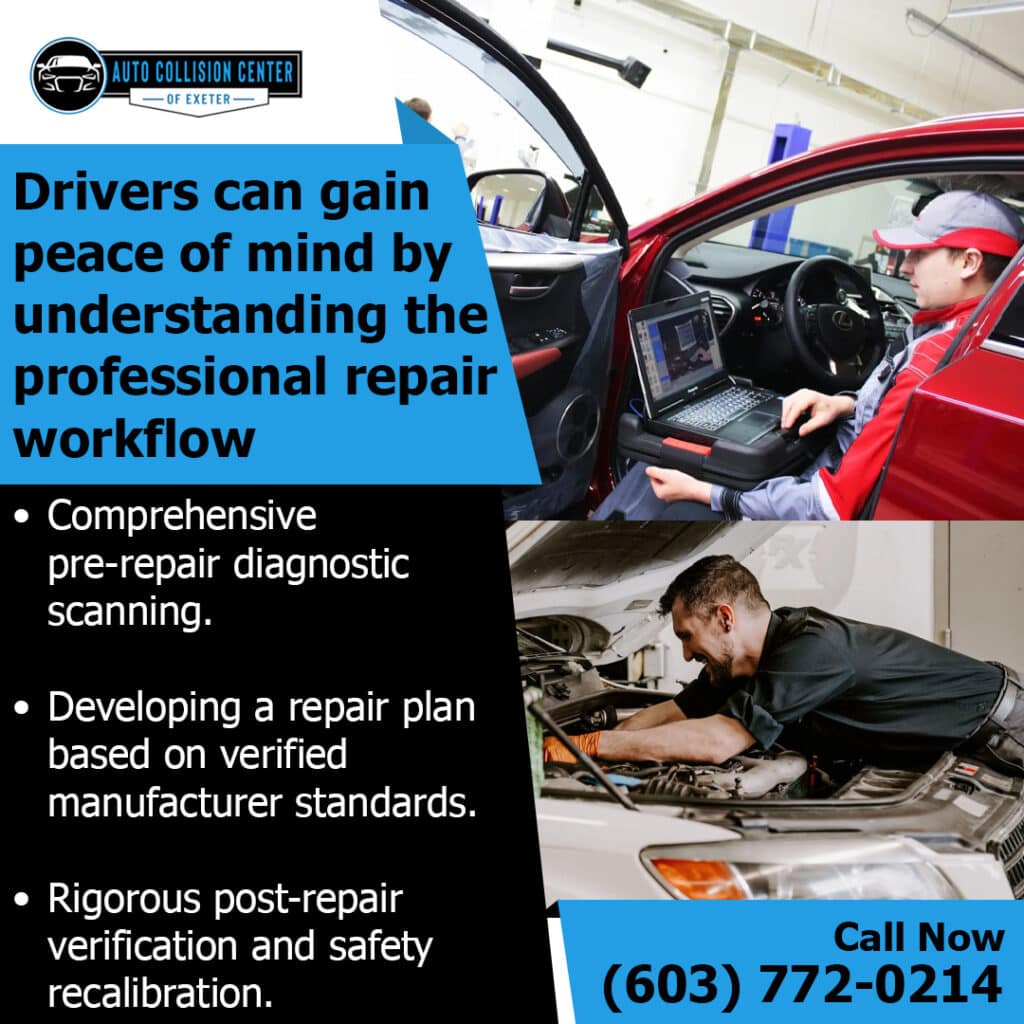
After reassembly, we run a post-repair diagnostic scan. This confirms that no fault codes remain and all electronic systems are functioning correctly.
If your vehicle has Advanced Driver Assistance Systems (ADAS) that were affected, calibration is coordinated through certified partners. ADAS functions, including automatic emergency braking and lane departure warning, depend on sensors positioned to precise tolerances. In May 2024, NHTSA finalized a rule mandating automatic emergency braking on all new passenger cars and light trucks (≤10,000 lbs), with manufacturers required to make AEB standard by September 2029. That decision reflects how central these systems have become to vehicle safety. Getting calibration right after a repair is not optional.
Road Testing and Quality Control
Every vehicle is test-driven before delivery. We evaluate braking response, steering behavior, alignment, and how the vehicle handles under real driving conditions. This step catches anything that scanning and visual inspection might not reveal. Your vehicle is not ready until it drives correctly. This final phase is a key part of professional auto body repair because it confirms that the vehicle is ready for real-world driving conditions.
How Long Does Collision Repair Take?
No two repairs follow the same timeline. The factors below are the primary drivers of how long the process takes. We give you a realistic estimate at the start and update you when anything changes.
| Factor | Typical Impact on Timeline |
| Minor repairs, no structural involvement | A few days, depending on parts and scope |
| Framework or multiple panel replacements | A week or more, depending on severity |
| OEM parts requiring ordering and lead time | May extend the timeline by several days |
| Insurance supplement requiring review and approval | Adds variable approval time |
| ADAS calibration coordination | Adds scheduling time through certified partners |
A repair done correctly takes the time it requires. Rushing any phase creates risk. What you can count on from us is honest communication at every stage.
What Sets Our Collision Repair Process Apart
Communication Built Into the Process
Bryan Dinger oversees all aspects of the shop’s operations, from quality control to customer communication. We prioritize transparency throughout, keeping you informed at every stage, from the initial inspection through final delivery.
OEM Procedures and Verified Equipment
We follow manufacturer-specified repair procedures for every job, across a 5,000 sq ft facility equipped specifically for modern collision repair. That means the Spanesi frame rack and laser measuring system for all structural work. Prospot welders handle metal joining. Snap-On and Bosch tools handle pre- and post-repair scanning. Our RM paint system and heated downdraft booth handle all refinishing. Nothing is improvised.
Safety Is the Measure, Not Appearance
A vehicle can look repaired and still have uncalibrated safety systems or a frame that is not square. We perform both a pre-repair and post-repair diagnostic scan on every vehicle. We test-drive each car before it leaves our facility. Our limited lifetime warranty backs every auto body repair in Exeter, NH, that we complete. The finish line is a safe car, not just one that looks fixed.
Frequently Asked Questions
Will my vehicle be safe after repairs?
Yes. We follow OEM repair procedures, perform both a pre-repair and post-repair diagnostic scan on every vehicle, and use only approved parts. Those three steps together are what restore a vehicle’s structural integrity and system function, not just its appearance. A car can look completely repaired and still have a frame that is not square or a safety system that is not calibrated. That is why we do not consider a repair finished until it meets the standard, not just the look.
Will the damage be completely fixed?
We repair everything we find, including damage that only becomes visible after disassembly, not just what was apparent at drop-off. We start every repair with a diagnostic pre-scan and full disassembly before the final estimate is written. That sequence lets us document hidden structural or system damage and include it in the repair scope. A visual inspection at intake gives us the starting point. Scanning and disassembly give us the complete picture.
What happens if additional damage is found?
We document it and submit it to your insurer as a supplement. We do not begin work on that additional damage until approval is received. We notify you when a supplement is filed, so you always know if the repair scope has changed and why.
Choosing the Right Auto Body Repair Shop in Exeter, NH
Choosing the right provider for auto body repair in Exeter, NH, that you can trust means looking beyond surface results. Not every shop has the training, equipment, or process discipline to handle modern vehicle repairs correctly. Here is what we bring to every repair:
We hold I-CAR Gold Class certification at the shop level. This confirms our team meets current industry training standards. According to industry estimates, fewer than 20% of collision repair shops nationwide hold I-CAR Gold Class status.
Our individual technicians hold I-CAR Platinum certification, confirming each person’s hands-on proficiency with today’s vehicles.
Our equipment covers the full scope of a proper repair. That includes Spanesi laser frame measuring and a heated downdraft paint booth. Snap-On and Bosch diagnostic tools run a scan before and after every repair.
We back every repair and paint job with a limited lifetime warranty. It is valid for as long as you own your vehicle.
We keep you informed at every stage, from inspection through delivery.
These are the standards behind our Exeter, NH auto body repair services.
The reviews customers leave us reflect our adherence to these standards. Here is what Sandy K. said in a Google review: “What a professional and stress-free experience I had at Auto Collision Center of Exeter. At my initial visit, Wendy kindly booked my repair appointment and set up my car rental. Bryan efficiently checked over my car and wrote up a preliminary estimate. They both were great communicators throughout the repair process. When done, my Mazda looked good as new, and I am a very satisfied customer. I would definitely return if I needed more excellent auto body repair work in the future.”
Schedule Your Estimate at Auto Collision Center of Exeter
Knowing what happens at each stage removes the uncertainty from a difficult situation. Every phase helps ensure the vehicle is restored to safe operating condition.
Bryan Dinger, our general manager, brings more than twenty years of collision repair experience. His technical foundation includes training from Universal Technical Institute. Our team carries fifty years of combined experience in collision and auto body repair services across the New Hampshire Seacoast.
Auto Collision Center of Exeter is a family-owned, I-CAR Gold Class-certified shop. We follow OEM procedures, use trusted parts, and back every repair with a limited lifetime warranty. We serve Exeter and the surrounding communities throughout the Seacoast region.
Call (603) 772-0214 or email us at accofexeter@gmail.com to schedule your free estimate. We are here to help.