Synopsis
Auto body damage affects door alignment, panel fit, and vehicle safety because collision forces shift structural components beyond the visible impact area. Auto Collision Center of Exeter addresses these through professional auto body repair that restores structure, safety, and vehicle value.
Key Takeaways
- Even low-speed collisions can shift door hinges, pillar mounting points, and panel gaps
- Door misalignment is a safety risk, not just a cosmetic problem
- Panel fit is a direct indicator of structural condition after a collision
- OEM and quality aftermarket parts restore correct fit and factory safety standards
After a collision, many drivers focus on visible damage. A dented panel, a scuffed bumper, a cracked trim piece. What they often miss are the changes happening beneath the surface. Shifts in door alignment, distorted panel gaps, and structural movement affect how the vehicle will perform if it is hit again.
Door fit and panel alignment are not cosmetic details. They are direct indicators of structural condition. When those details change after a collision, the vehicle needs more than paint and panel work. It needs a thorough inspection and, in many cases, structural correction.
Auto Collision Center of Exeter provides auto body repair Exeter NH drivers rely on, focusing on structural accuracy, safety, and long-term performance. Bryan Dinger, our general manager, brings over a decade of collision repair experience to every assessment. His technical training from Universal Technical Institute gives him the background to identify what a visual check alone will miss. That experience shapes how we approach every job.
What Happens to Your Vehicle’s Structure After a Collision?
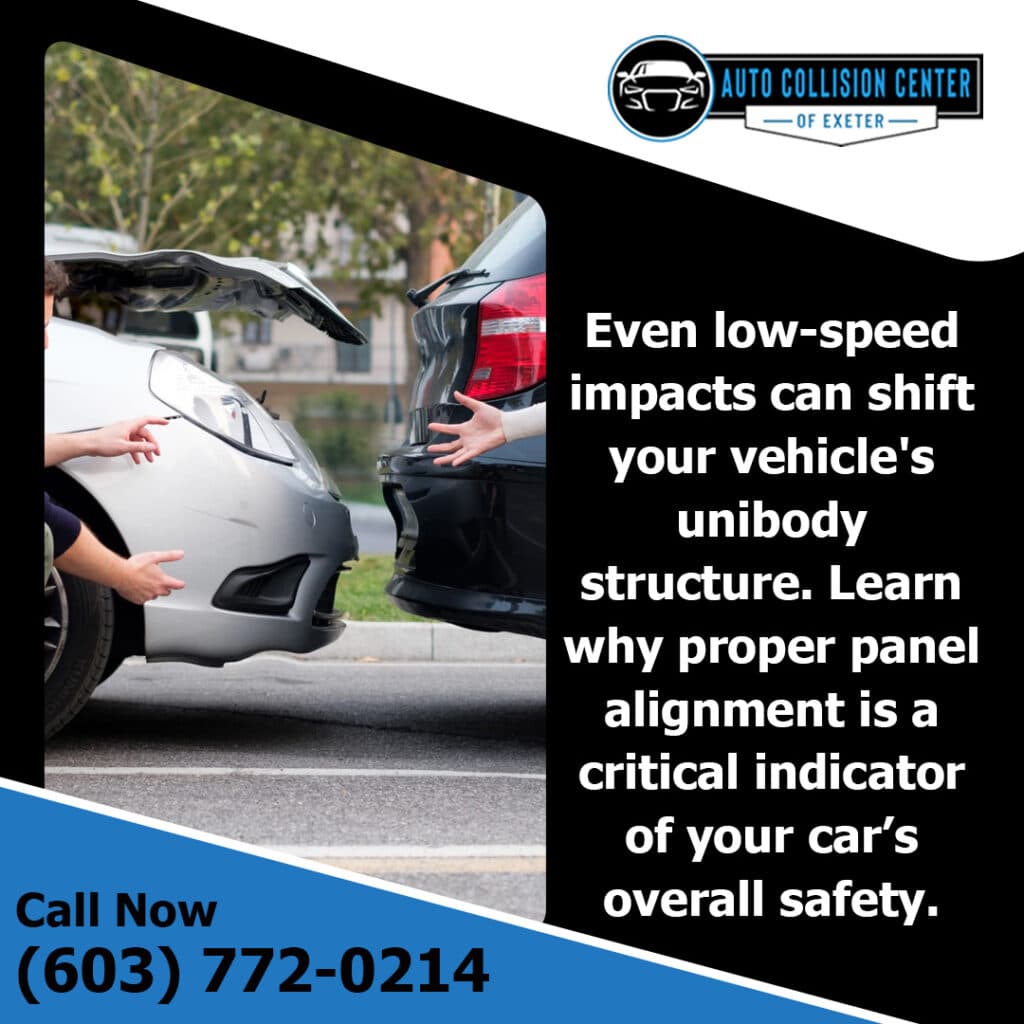
Most modern vehicles use unibody construction. This means the body and frame are built as one integrated structure, not two separate parts. When a collision occurs, impact energy travels through that entire system. Even in low-speed accidents, forces spread along metal panels, pillars, and mounting points well beyond the point of contact.
Structural shifts often occur several feet from where the impact happened. That is why a minor-looking dent can produce door alignment problems or irregular panel gaps that do not show up until days or weeks after the accident.
Why Small Impacts Can Cause Larger Alignment Problems
Low-speed collisions are often dismissed as cosmetic. In practice, they can cause:
- Hinge shifting or loosening
- Distortion of door opening flanges
- Bracket or mounting point displacement
- Latch misalignment at the striker
None of these problems is visible without disassembly and precise measurement.
How Auto Body Damage Affects Door Fit and Operation
Doors mount to specific points along the vehicle’s pillars and are aligned to close within tight factory tolerances. When the surrounding structure shifts, the door fit changes.
After a collision, common door-related symptoms include:
- Doors requiring extra force to close fully
- Visible gaps wider on one side than the other
- Wind noise or water entry along door seals
- A door sitting higher or lower than before the accident
Why Door Misalignment Is a Safety Issue
A door that does not close and latch correctly is a safety hazard. Federal Motor Vehicle Safety Standard No. 206 specifies load thresholds that door latch systems must withstand to minimize occupant ejection during a crash. It is a federal regulation administered by the National Highway Traffic Safety Administration. Those standards assume the latch is correctly seated and the door is properly aligned.
When misalignment reduces latch-striker engagement, a door is more likely to open under load in a secondary impact. Side door airbag timing can also be affected when pillar geometry shifts, because sensors no longer sit at factory positions.
Hidden Causes Behind Door Fit Issues
Door fit problems do not always originate at the door itself. Common hidden causes include:
- A, B, or C-pillar structural shifts: the vertical members that door hinges and strikers mount to
- Frame or rocker panel deformation: the lower structure supporting the entire door opening
- Improperly corrected previous repairs: doors adjusted cosmetically without addressing the underlying misalignment
How Panel Damage Impacts Fit, Gaps, and Vehicle Integrity
Panel gaps are the spacing between adjacent body components, such as hood-to-fender, door-to-quarter panel, or bumper-to-fascia. Manufacturers set these to precise tolerances for aerodynamics, structural sealing, and appearance. When collision damage shifts structural components, panels no longer sit in their designed positions.
Signs of Improper Panel Fit
After a collision, watch for:
- Gaps wider on one side of a door than the other
- Hood edges sitting higher or lower than adjacent fenders
- Body lines that do not align across panel seams
- Panels that press against adjacent components when closed
Why Panel Fit Reflects Underlying Damage
Poor panel fit reflects structural misalignment, not just cosmetic damage. A hood sitting too high may indicate front rail damage. A quarter panel with inconsistent gaps may signal inner structure deformation. Panels replaced without structural correction will show the same problems again.
This is why we do not simply swap panels and call the job complete. For car body repair in Exeter, NH, involving panel displacement, we measure the underlying structure and correct it first.
The Safety Risks Linked to Poor Fit and Misalignment
Vehicle safety systems are designed around factory geometry. When post-collision dimensions deviate from specifications, those systems cannot perform as designed.
| Safety System | How Misalignment Affects Performance |
| Door latch and retention | Reduced latch engagement increases ejection risk |
| Side curtain and door airbags | Pillar shift alters sensor position and deployment timing |
| Forward Collision Warning (FCW) | Sensor displacement affects detection accuracy |
| Automatic Emergency Braking (AEB) | Requires correct structural positioning post-repair |
| Crumple zones | Prior deformation changes the energy distribution in a future crash |
According to the most recent NHTSA-led PARTS study analyzing approximately 98 million vehicles and 21.2 million crashes across 16 states, vehicles equipped with both forward collision warning and automatic emergency braking experienced 49% fewer front-to-rear crashes than those without these systems. These systems rely on sensors positioned precisely relative to the vehicle’s structure. Professional auto body repair that skips structural correction compromises safety system performance and overall vehicle protection.
Why Measurement and Diagnostics Come First
Correct repair starts before any part is touched. At Auto Collision Center of Exeter, the process follows a documented sequence:
- Pre-repair scan using Snap-On and Hunter/Bosch tools: Reads active fault codes across safety, airbag, and sensor systems before disassembly
- Full disassembly of damaged areas: Removes outer panels to reveal damage to inner structure and mounting points
- Structural measurement using Spanesi equipment: Compares current unibody dimensions to manufacturer specifications and flags deviations
- Damage mapping: Records all findings before repair authorization is submitted to the insurer or customer
Deviations of just a few millimeters can affect crash energy distribution, door seal integrity, and restraint system performance.
How We Restore Proper Fit and Safety
Professional auto body repair corrects the structure first, not just surface appearance. Our I-CAR Platinum-certified technicians work to OEM standards at every phase. The repair sequence for door and panel work includes:
- Structural correction of pillars, inner panels, or frame before any panel work begins
- OEM or quality aftermarket parts sourced from trusted suppliers, never from unverified online sources
- Panel pre-fitting before paint: confirms correct gaps, door closure, and body line alignment. Issues found at this stage are corrected before any finish is applied.
- RM paint system with computerized color matching: our camera analyzes your vehicle’s exact color before the finish coat is applied
- Post-repair scan: a second electronic check confirms all system codes have cleared
- Road test before delivery: checks alignment, feel, braking, and system response under real driving conditions
- ADAS recalibration is coordinated when sensors are displaced or safety codes are present after repair
Every repair is backed by a limited lifetime warranty on all work and paint, for as long as you own the vehicle.
What Exeter, NH, Drivers Should Watch for After a Collision
New Hampshire winters increase minor collision risk. Ice, reduced visibility, and road debris contribute to low-speed impacts that drivers often dismiss. After any collision in the Exeter area, check for these signs before deciding no repair is needed:
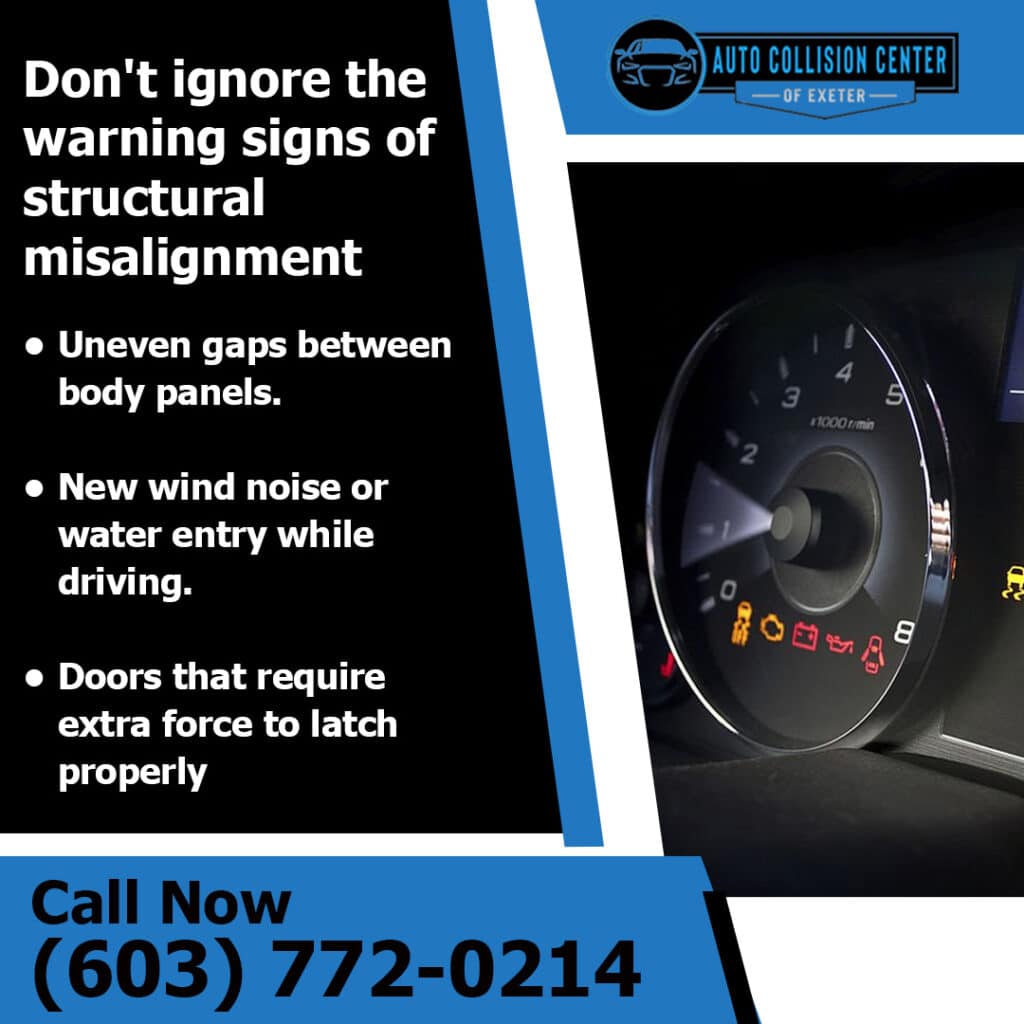
- New warning lights, particularly airbag, stability, or lane assist indicators
- Wind noise or water entry along door or window seals that was not there before
- Any change in how doors sound or feel when closing
- Gaps around doors or the hood that look different from the other side of the vehicle
Early inspection costs far less than addressing structural damage that has been ignored for weeks.
Why Structural Repair Matters More Than Appearance
Door fit, panel alignment, and vehicle safety point to the same structural condition. A vehicle with misaligned doors and distorted panel gaps has compromised crash performance, regardless of how it looks.
Repairs that restore only appearance leave structural problems unaddressed. At Auto Collision Center of Exeter, our I-CAR Gold Class certified shop brings more than fifty years of team experience to every job. Our process is built around measurement, correction, and verification, in that order.
If your vehicle has been in a collision and you are noticing door, panel, or seal issues, the right step is a full structural assessment. Our Exeter, NH auto body repair services are built around identifying hidden damage and restoring proper structural alignment. Contact us at (603) 772-0214 or accofexeter@gmail.com. Our team at 58 Winter Street in Exeter will assess the full scope of the damage before any repair begins.