Synopsis
Certified auto body repairs use OEM procedures and system checks to restore safety and performance. Standard fixes often address only visible damage, missing hidden issues that can affect reliability and value.
Key Takeaways
- Certified repairs confirm structural alignment and system functionality
- Diagnostic scans detect hidden damage beyond visible panels
- ADAS calibration restores safety system accuracy
- OEM procedures support durability and crash protection
Most drivers want their car back safely. Two shops can make a car look identical. The key difference is in what is checked and verified under the surface.
As a certified auto body shop in Exeter, NH, every repair at Auto Collision Center of Exeter follows a documented workflow tied to manufacturer standards. Standard shops may handle visible bodywork adequately. For late-model vehicles with interconnected safety systems, however, how a repair is carried out determines whether those systems still work correctly.
What Makes a Certified Auto Body Shop Different From a Standard Auto Body Shop
The difference is not equipment alone. It is a structured, role-specific training requirement that applies to every person involved in the repair and must be renewed annually.
What Certification Requires Across the Whole Team
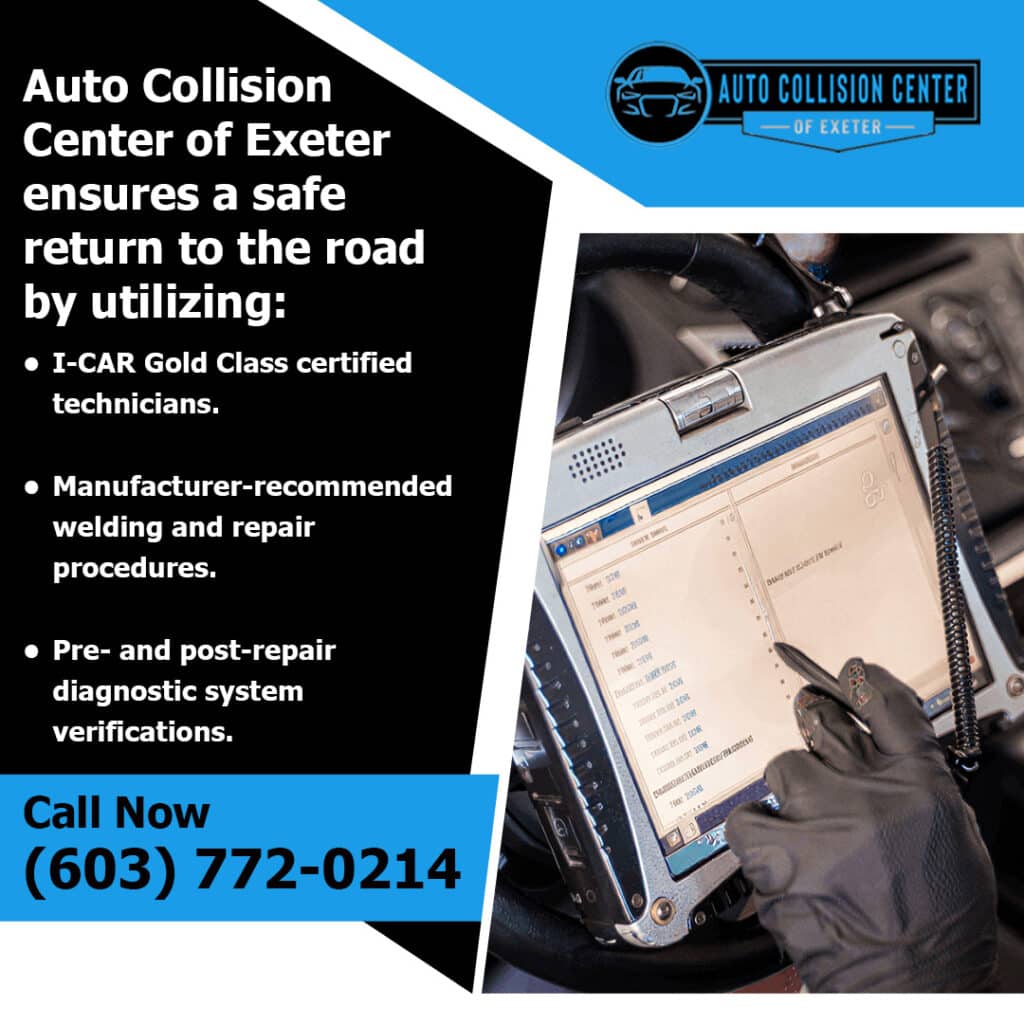
I-CAR Gold Class is the industry’s highest shop-level recognition. It requires every key role: estimator, structural technician, non-structural technician, and refinish technician, to maintain current, role-specific training. The whole team meets the standard, not just individual technicians. That is how we approach every repair.
This matters because a repair passes through multiple hands. An estimator without training in modern vehicle construction may miss hidden damage at the estimate stage. A technician using the wrong joining method on high-strength steel can weaken a structural member even when the finished panel looks correct.
At the individual level, I-CAR Platinum certification recognizes technicians who have demonstrated mastery in their specific repair role and maintain that knowledge year after year.
Why the Training Gap Shapes Outcomes
Standard shops typically have no requirement to follow manufacturer procedures, use calibrated measuring equipment, or perform diagnostic scans. Their technicians may produce acceptable bodywork. But they may lack the training in sensor placement, material-specific repair methods, and electronic system behavior that late-model vehicles require. Choosing a trusted certified auto body shop in Exeter, NH, means the repair process follows verified procedures, not assumptions.
Why Auto Body Damage Repair Goes Beyond Surface Fixes
Collision damage on a modern vehicle rarely stays at the surface. Structural components, electronic control modules, and safety sensors beneath the panels all need to be checked, not assumed to be unaffected.
What a Visual Check Cannot Find
A walk-around after a collision shows panel deformation, paint transfer, and obvious dents. It does not show bent structural rails, shifted unibody geometry, or fault codes stored in airbag and braking modules. A low-speed rear impact can displace a radar sensor from its calibrated position. A side impact at a door pillar can compress structural members that look intact from the outside. Without disassembly and frame measurement, both conditions go undocumented.
Why Safety System Verification Cannot Be Skipped
Advanced Driver Assistance Systems depend on sensors precisely aligned to the vehicle’s geometry. These include automatic emergency braking, lane departure warning, blind spot monitoring, and forward collision alert. A repair that shifts an adjacent panel changes that alignment.
A January 2025 study by the Partnership for Analytics Research in Traffic Safety (PARTS, a NHTSA-industry collaboration operated by MITRE, analyzed 98 million vehicles and found autonomous emergency braking (AEB) systems reduced front-to-rear crashes by 49% across model years 2015–2023, with effectiveness improving from 46% (2015–2017) to 52% (2021–2023).n the most recent vehicles studied, model years 2021 to 2023, that figure reached 52%. A system left unverified after auto body repair cannot reliably deliver those results.
We coordinate ADAS recalibration through certified partners after any auto body damage repair in Exeter, NH, that affects sensor-adjacent components. Most standard shops do not account for this step.
How the Certified and Standard Approaches Differ at Each Stage
The gap between certified and standard car body repair runs through every stage, from first intake to final delivery.
Intake: Diagnostic Scanning vs. a Walk-Around
When a vehicle arrives, we run a full pre-repair diagnostic scan using Snap-On and Bosch tools. We check every electronic module for recorded fault codes before any work begins. A triggered airbag module or a displaced sensor leaves no visible sign. These conditions are identified at this stage, not discovered later.
Auto Collision Center of Exeter also documents each vehicle with a complete photo record at check-in, inside and out. This supports accurate insurance reporting and protects the customer throughout the repair.
Assessment: Structural Measurement vs. Visual Judgment
After check-in, we fully disassemble the damaged area. Panels that appear lightly damaged often conceal bent structural rails or shifted mounting points underneath. We use a Spanesi laser frame-measuring system to verify the vehicle’s frame or unibody against factory specifications. Measurements are taken at multiple reference points and compared against the manufacturer’s data for that specific model.
Without calibrated measuring equipment, a standard shop cannot confirm structural alignment. It can straighten what is visible. It cannot verify that the vehicle’s geometry has actually been restored.
Repair: OEM Procedures and Matched Refinishing
Every car body repair we complete follows OEM procedures. These specify the correct welding method, sectioning locations, part grades, and adhesive types for each vehicle model. Our Prospot welding equipment meets manufacturer specifications for structural repairs.
For refinishing, we use an RM paint system with a computerized color-matching camera. This analyzes the vehicle’s exact color before any paint is applied, accounting for aging and fading in the existing finish that a standard color-code match cannot replicate.
For parts, OEM is our preference for every repair. When insurance requires aftermarket, we use quality-verified suppliers only.
Delivery: Post-Scan and Road Test vs. Reassembly Alone
When repairs are complete, we run a second diagnostic scan. This confirms all fault codes have been cleared. It also confirms that no new codes were introduced during the work. If ADAS components were affected, recalibration is coordinated through certified partners before the vehicle leaves.
A road test checks braking response, steering behavior, and system function under real driving conditions. Standard repairs often end at reassembly. Ours ends when the vehicle has been verified.
Where Standard Auto Body Repair Shops Commonly Fall Short
Shortcuts in collision repair are not visible at pickup. They tend to surface later: in a failed pre-purchase inspection, in a safety system that does not activate, or in how a vehicle performs in another impact.
Common gaps in non-certified repair workflows:
- No structural measurement: Alignment is assumed corrected rather than confirmed with calibrated equipment
- No ADAS verification: Safety systems are returned to the customer without confirmation
- Non-OEM parts from unverified sources: Fitment and safety tolerances may not match factory specifications
- No diagnostic verification: Electronic conditions are neither identified at intake nor confirmed at delivery
None of these conditions is visible when the customer picks up the vehicle. Issues surface in another collision, during a dealership diagnostic check, or when a buyer’s pre-purchase inspection finds incomplete repair documentation.
Why Certified Repairs Protect Both Safety and Resale Value
A certified repair restores more than appearance. It restores the structural and electronic integrity that determines how a vehicle performs and how it holds its value.
Repairs done to OEM standards maintain the vehicle’s designed crash protection. Crumple zones function as engineered. Airbag deployment positions are preserved. These outcomes depend on accurate structural repair, not on how the vehicle looks from the outside.
For resale, documentation matters. A repair backed by scan records, structural measurement, and confirmed parts sourcing holds up under a pre-purchase inspection. One without that documentation raises questions that lower trade-in offers.
Repair quality also affects how ADAS systems perform after the work is done. Systems left unverified after a repair cannot be relied on to reduce crash risk the way they were designed to. That matters both for your safety and for the vehicle’s long-term insurance and resale standing.
| Stage | Our Certified Repair Process | Standard Repair |
| Intake | Pre-repair scan, Snap-On and Bosch tools | Walk-around only |
| Structural check | Spanesi laser frame-measuring system | No calibrated measurement |
| Repair method | OEM procedures, Prospot welding | No OEM requirement |
| Paint matching | RM system with a computerized color-matching camera | Standard color-code match |
| Post-repair | Scan, ADAS verification, road test | Reassembly; no verification |
| Warranty | Limited lifetime on all repairs and paint | Varies |
Why Auto Body Shops Near You Return Different Quality Levels
After an accident, the nearest available shop feels like the practical choice. But proximity does not tell you whether a shop runs diagnostic scans, measures structural alignment, or verifies safety systems before returning your vehicle.
A repair that actually includes scans, structural measurement, OEM procedures, and system verification is a more reliable basis for choosing an auto body repair shop than how close it is. That distinction matters most when the vehicle faces another impact, or when it comes time to sell.
After an accident, you may search for an auto body shop near you to get quick help. Location matters, but the repair process matters more. A nearby shop should still follow diagnostic, structural, and safety verification steps before returning your vehicle.
Is Affordable Auto Body Repair Worth It When the Process Is Skipped
A lower initial repair cost can carry a higher long-term risk when the repair skips diagnostic verification, structural measurement, and ADAS checks.
While affordable auto body repair may seem appealing upfront, repairs that skip verification steps can lead to higher costs later. Insurance is designed to restore a vehicle to its pre-accident condition. Whether that standard is actually met depends on the shop. A repair that skips key verification steps may cost less upfront. Addressing what was missed later or dealing with a safety system that failed to perform costs far more.
Our limited lifetime warranty covers all repairs and paint work for as long as you own the vehicle. That coverage reflects the documentation and verification behind every repair we complete. A warranty without a verifiable process behind it offers little practical protection.
Frequently Asked Questions
What is the main difference between a certified and a standard auto body repair?
A certified repair follows OEM procedures, uses calibrated equipment, and verifies all vehicle systems before and after the work. A standard repair addresses visible damage but may not check structural or electronic conditions beneath the surface.
Does every collision need a diagnostic scan?
Any late-model vehicle with electronic safety systems should have a pre-scan and a post-scan. Fault codes triggered by an impact are not visible and will not clear on their own without being addressed.
How do I know if my vehicle’s safety systems were verified after a repair?
Ask for the pre- and post-scan reports. A certified shop can produce them. If a shop has no scan documentation, that step was not performed.
Certified Auto Body Repairs Are the Safer Long-Term Choice
A repair that stops at surface appearance leaves the rest of the vehicle unverified. On a late-model vehicle, that means the safety systems and structural geometry that protect occupants may not have been checked at all.
Auto Collision Center of Exeter follows I-CAR Gold Class standards on every repair. Our team brings more than 50 years of combined experience in auto body and collision repair, and our technicians hold current I-CAR Platinum certification. Bryan Dinger, our general manager, brings over a decade of collision repair expertise backed by I-CAR Platinum certification and Universal Technical Institute training.
If your vehicle has been in an accident, call us at (603) 772-0214 or email accofexeter@gmail.com to schedule your free estimate. Our certified auto body shop is located at 58 Winter Street, Exeter, NH. We will walk you through the damage found, what the repair involves, and what to expect before work begins.