Synopsis
After a collision, fast is not the same as done right. At Auto Collision Center of Exeter, we know that quality-first car body repair in Exeter, NH protects your safety, preserves your vehicle’s resale value, and prevents the cost of fixing work that was rushed the first time.
Key Takeaways
- Speed and quality are not the same thing. A repair that looks done at pickup may have skipped steps that matter.
- Incomplete disassembly hides structural damage that affects your safety and handling.
- A certified auto body shop documents every repair stage and follows OEM procedures.
- Skipping post-scan verification leaves your vehicle’s safety systems unconfirmed.
- The genuinely affordable repair is the one you do not pay for twice.
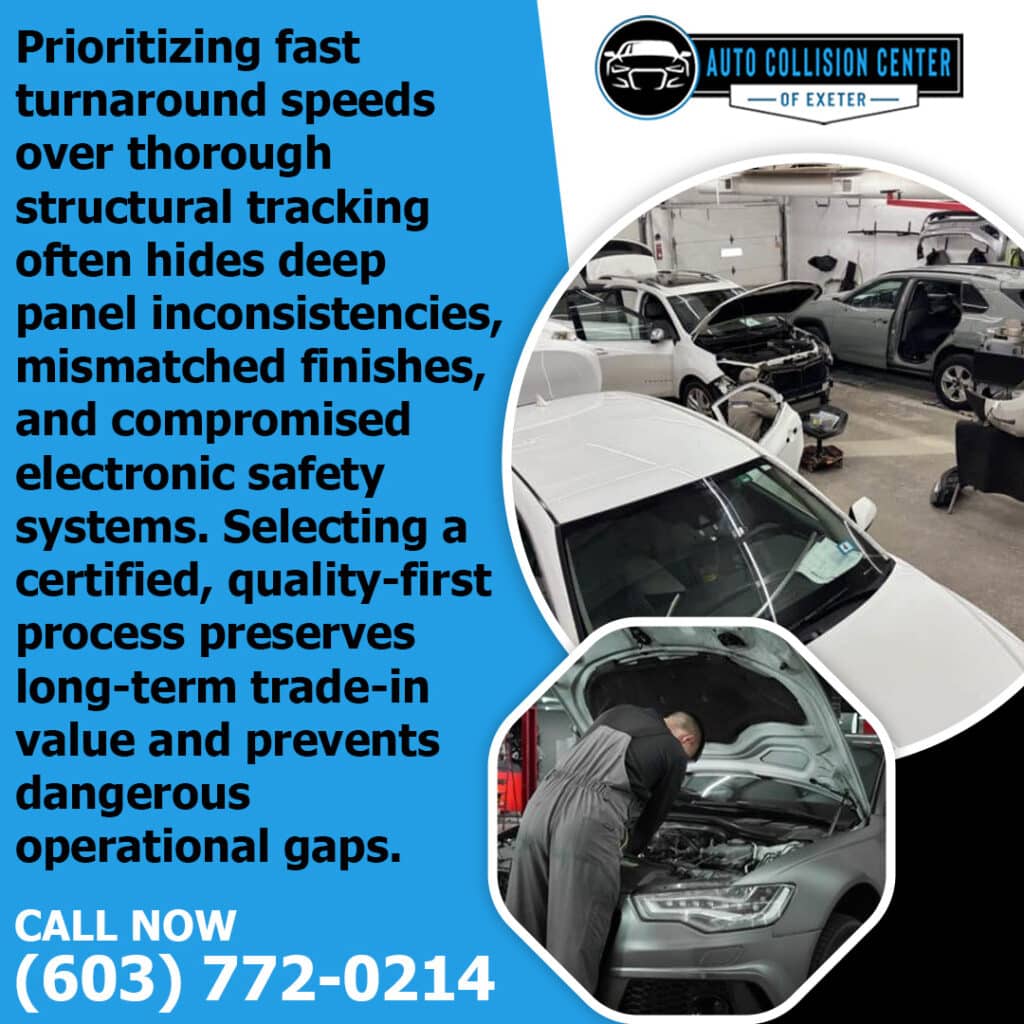
After an accident, the pressure to move fast is real. Your insurer pushes for a quick turnaround. You see shops advertising same-week estimates. You just want your car back. That urgency is understandable. But speed and quality are not the same thing. Your car can come back looking repaired without actually being repaired correctly. We see it happen. A rushed repair looks fine at pickup, then problems surface later: a door that does not fit right, paint that fades unevenly, or a safety system that was never confirmed after reassembly.
Auto Collision Center of Exeter explains what quality-first car body repair involves, why each step matters for you, and what to look for in an auto body repair shop.
What Rushed Auto Body Repairs Often Leave Behind
When a shop prioritizes speed, it compresses or skips the steps that take the longest. These shortcuts are common in rushed auto body damage repair, and each one affects your vehicle:
- Skipping disassembly, so hidden structural damage goes undetected beneath your panels
- Bypassing pre-repair diagnostic scans, leaving fault codes from your collision unaddressed
- Ordering parts before damage is fully assessed, forcing workarounds that affect fit and finish
- Rushing panel pre-fitting, causing gaps and misalignment, you notice weeks later
- Applying paint without proper priming can cause premature peeling or a color mismatch
None of these is visible when you pick up your car. They surface over time, and by then your vehicle is already back in your hands.
Why Disassembly and Damage Assessment Cannot Be Rushed
Collision force travels through your vehicle’s structure in ways that are not visible from outside the panels. A rear impact can shift a unibody rail or compress a structural pillar, and you would not know either had happened just by looking.
Finding it requires disassembly and frame measurement. We use Spanesi laser measuring equipment to verify your vehicle’s structural geometry against manufacturer specifications, taking measurements at multiple reference points and comparing them to factory data for your specific model.
Skipping this step restores the appearance of your car. It does not confirm whether the structure is correct. Those are different outcomes, and only one of them protects you in the event of another impact.
How Repair Quality Affects Your Vehicle’s Resale Value
Once your vehicle has been involved in a collision, that history may be recorded in vehicle history databases such as CARFAX or AutoCheck, depending on how the incident and repairs were reported. You cannot erase it. What you can control is how much additional value is lost through the quality of the repair.
When a repair is rushed, it leaves visible signs: misaligned panels, paint that does not match under natural light, and uneven gaps around your doors and trim. Buyers and appraisers see these things and lower their offers. When your repair is completed to OEM standards with documented parts, scan records, and verified frame measurements, buyers and appraisers have greater confidence in the quality of the repair.
The table below shows how the repair approach shapes long-term outcomes:
| Repair Approach | What You See at Pickup | What Happens Long-Term |
| Speed-first (shortcuts) | Looks repaired at delivery | Panel gaps, paint fade, reduced resale value, re-repair risk |
| Quality-first (OEM process) | Looks and performs correctly | Structural integrity retained, resale value preserved, documented repair history |
The genuinely affordable auto body repair is the one you do not have to pay for twice. A lower initial estimate that skips verification steps can lead to additional repair costs if underlying issues are discovered later.
What a Quality Auto Body Repair Process Includes
Not every auto body repair shop completes every step. Here is what we do on every job, and what you should expect from any shop you choose:
- Check-in documentation: We photograph your vehicle inside and out before any work begins. About 100 photos document its condition and protect your interests throughout the repair.
- Pre-repair diagnostic scan: Your collision may have triggered fault codes that are not visible. We use Snap-On and Bosch tools to identify them before repairs start.
- Disassembly and frame measurement: We remove your panels and measure your frame or unibody geometry against manufacturer specifications using Spanesi laser measuring equipment.
- Structural repair: We complete all metal work using Prospot welding equipment and OEM repair procedures to restore your vehicle’s factory crashworthiness.
- Parts sourcing: OEM parts are always our first choice. When your insurer requires aftermarket, we use quality-verified suppliers only. We never source parts from Amazon, eBay, RockAuto, or other unverified sources.
- Panel pre-fitting: We fit-check all parts and confirm body lines and gaps before your vehicle moves to paint.
- Paint and refinishing: Our RM paint system uses a computerized color-matching camera to read your vehicle’s actual color before paint is mixed and applied inside a heated downdraft booth.
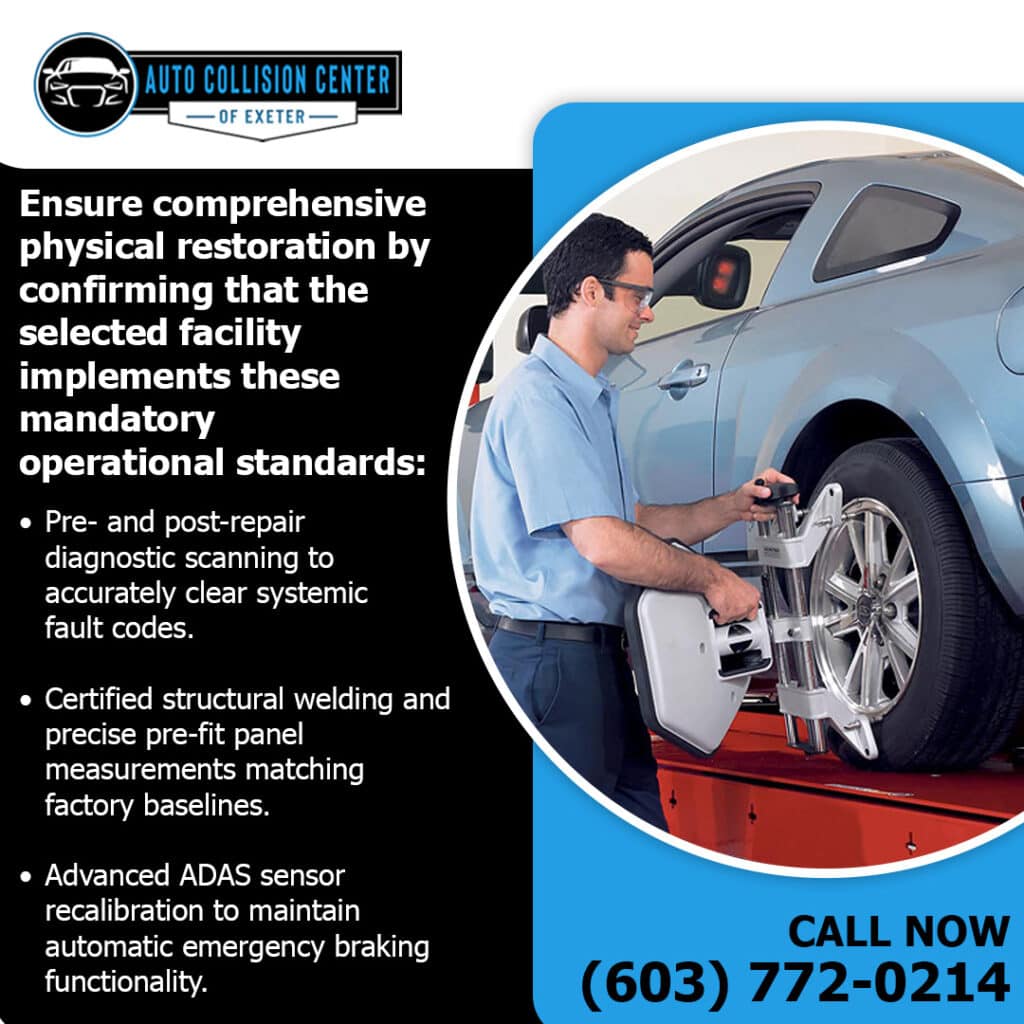
- Post-repair scan: We run a second scan after reassembly to confirm all fault codes are cleared, and no new codes were introduced.
- Road test: We test your vehicle’s braking, steering, and handling under real driving conditions before returning it to you.
Why Diagnostic Scanning Belongs at Both Ends of Your Repair
A pre-scan catches fault codes that your collision triggered. A post-scan finds anything new that appeared during reassembly: a wiring issue, a misrouted connector, or a sensor disturbed during panel fitting. If a shop skips the post-scan, your car goes back to you unverified. You may not find out until a warning light appears or until another collision reveals what was missed.
If your vehicle has ADAS features such as automatic emergency braking, lane departure warning, or blind spot monitoring, those systems depend on sensors precisely aligned to your vehicle’s geometry. Any repair affecting nearby panels may require recalibration. We coordinate ADAS recalibration through certified partners and assess whether it applies to every job.
Why ADAS Verification Matters After Your Collision
A study by the Partnership for Analytics Research in Traffic Safety (PARTS), a NHTSA-industry collaboration, analyzed 98 million vehicles. It found AEB systems reduced front-to-rear crashes by approximately 50% across model years 2015 to 2023. For 2021 to 2023 models, that figure reached 52%. A system returned to you unverified after a repair cannot reliably deliver those results.
Does Turnaround Time Matter At All?
Yes. When your car is your only transportation, every extra day costs you something real.
Speed comes from efficiency or from skipping steps. We assess damage thoroughly upfront, which prevents mid-repair delays when hidden damage surfaces and supplement approvals are needed. We also handle your insurance coordination directly, managing the documentation and advocating for the repairs your vehicle actually needs.
When you search for an auto body shop near you after an accident, proximity is a practical first step. As a family-owned collision repair shop, we are personally invested in every outcome. At Auto Collision Center of Exeter, we give you a realistic timeline at the start and keep you informed as the repair progresses.
Speed through efficiency is good. Speed through skipped steps is a problem you will deal with later.
What To Look for in a Certified Auto Body Shop in Exeter, NH
Not every auto body repair shop holds the same standards. When evaluating your options, here are the quality signals that matter:
- Documented certification: Ask whether the shop holds I-CAR Gold Class status. It requires ongoing, role-specific training for every key position and is renewed annually.
- OEM procedure adherence: Ask which procedures the shop follows for your specific vehicle. OEM procedures specify welding methods, sectioning points, and part grades by model.
- Parts policy transparency: Ask where parts come from and what the difference is between OEM and aftermarket for your vehicle.
- Post-repair warranty: Ask what the warranty covers. A warranty covering all repairs and paint for as long as you own your vehicle is the standard to look for.
- Scan documentation: Ask for the pre- and post-repair scan reports. We produce both for every repair we complete.
Why I-CAR Gold Class Certification Signals Repair Quality
I-CAR Gold Class is the collision industry’s highest shop-level recognition. Only about 20% of shops nationwide hold it.
What makes it meaningful is the requirement for ongoing training across every role: estimators, structural technicians, non-structural technicians, and refinish technicians. It is not earned once. Every role renews annually. At the individual level, I-CAR Platinum recognizes technicians who have demonstrated and maintained role-specific mastery. Shop-level and individual-level are separate designations, and both matter for your repair.
Our 5,000 sq ft facility is equipped for every stage of a proper repair. Auto Collision Center of Exeter holds I-CAR Gold Class at the shop level and I-CAR Platinum at the individual technician level. We are also a Direct Repair Program partner with State Farm, Geico, and Amica, meaning our process has been reviewed and accepted by major insurers.
The customer feedback we receive shows how much clients appreciate our quality work. Here is a Google review from our customer, Cameron. “I cannot believe the quality of work these guys did to my car. I was so upset after my accident, but they literally made my car look brand new. Honestly better than even before I got hit! Thank you so much!!! “
What “Affordable Auto Body Repair” Actually Means or You
Affordable does not mean the lowest estimate. It means you do not have to pay for the same repair twice.
When a shop skips diagnostic scans, structural measurement, or post-repair verification, you may pay less upfront. But if structural work was missed, if a panel was painted without proper priming, or if a safety system was returned to you unverified, those corrections fall to you later. The costs are real and yours to absorb.
Our warranty covers all repairs and paint work for as long as you own your vehicle. That means something because the process behind it is documented: your scan records, your frame measurements, verified parts, and confirmed post-repair status. A warranty without a documented process is just a phrase. The process is what makes it worth something to you.
Why ADAS matters on your newer vehicle
In May 2024, NHTSA finalized Federal Motor Vehicle Safety Standard No. 127, mandating automatic emergency braking (including pedestrian AEB) and forward collision warning on nearly all new passenger cars and light trucks by September 2029. NHTSA projects this rule will save at least 360 lives and prevent at least 24,000 injuries each year. If your vehicle has these systems and they are not verified after a collision repair, they may not work as designed when you need them.
Frequently Asked Questions
How do I know if my auto body repair was done correctly?
Check four things when you pick up your car: panel gaps are even on all sides; paint matches under natural light; no warning lights are on; and doors and windows open and close smoothly. Then ask for the post-scan report. We produce one for every job we complete.
Can a rushed repair affect my insurance or resale value?
Yes, on both counts. An incomplete repair can appear in your vehicle history report and reduce what you receive at trade-in or private sale. For a future insurance claim, an adjuster may question whether new damage is from your current accident or from prior work that was never properly completed.
Is a certified auto body shop more expensive than a standard shop?
Certification does not automatically mean a higher price. It means documented procedures, verified parts, and diagnostic checks at both ends of your repair. Any price difference is typically offset by not returning for work that was missed the first time.
Schedule Your Free Estimate at Auto Collision Center of Exeter
After your collision, the right question is not how fast you can get your car back. It is whether the repair will hold up, keep your family safe, and protect what you have invested in your vehicle.
We document every repair from check-in through delivery, backed by our limited lifetime warranty on all work and paint. General Manager Bryan Dinger brings more than twenty years of hands-on collision repair experience and Universal Technical Institute training. Our team brings fifty years of combined experience in collision and auto body repair.
Call us at (603) 772-0214 or email accofexeter@gmail.com to schedule your free estimate at our certified auto body shop in Exeter, NH. We serve Exeter and nearby communities across the New Hampshire Seacoast. Our team is committed to delivering lasting repairs that restore your vehicle to its pre-accident condition while maintaining its safety and structural integrity.