Synopsis
A vehicle that looks repaired after a collision is not always a vehicle that has been repaired correctly. Professional auto body repair restores structural integrity, safety system function, parts quality, and paint system performance. All of these determine how your vehicle holds up on the road and in a future collision.
Key Takeaways
- A clean finish on your vehicle confirms nothing about frame geometry or safety systems.
- OEM repair procedures determine whether your car meets its original crash performance standards.
- The parts used in your repair determine how long it holds up under real-world driving.
- Your lifetime warranty is only as strong as the repair procedures and materials behind it.
- When you choose certified auto body repair, you get documented repair standards, not visual inspection alone.
After an accident, the most common question is: Does my car look right? That is a reasonable question, but it is not the right one.
Your vehicle can pass a visual check and still have problems. Frame geometry may be out of specification. Safety sensors may no longer sit at the correct angles. Paint may be sealing over improperly fitted panels.
At Auto Collision Center of Exeter, our team brings fifty years of combined auto body repair experience. We see the results of cosmetic-only repairs regularly. Vehicles arrive with widened panel gaps, paint failing at seam edges, and warning lights appearing months after a prior repair. The finish looked fine at delivery. The underlying repair was not done correctly.
That gap between what your vehicle looks like and what it actually is should not exist after a correct repair. Closing that gap is what our professional auto body repair in Exeter, NH, is about.
What “Restored to Pre-Accident Condition” Actually Means
This phrase appears on almost every estimate and in most insurance policies. You may assume it means your car will look the way it did before the accident. It means something more specific than that.
Pre-accident condition means the vehicle meets the same structural geometry, load path integrity (how the frame channels collision forces away from occupants), safety system calibration, and panel tolerances it had from the factory.
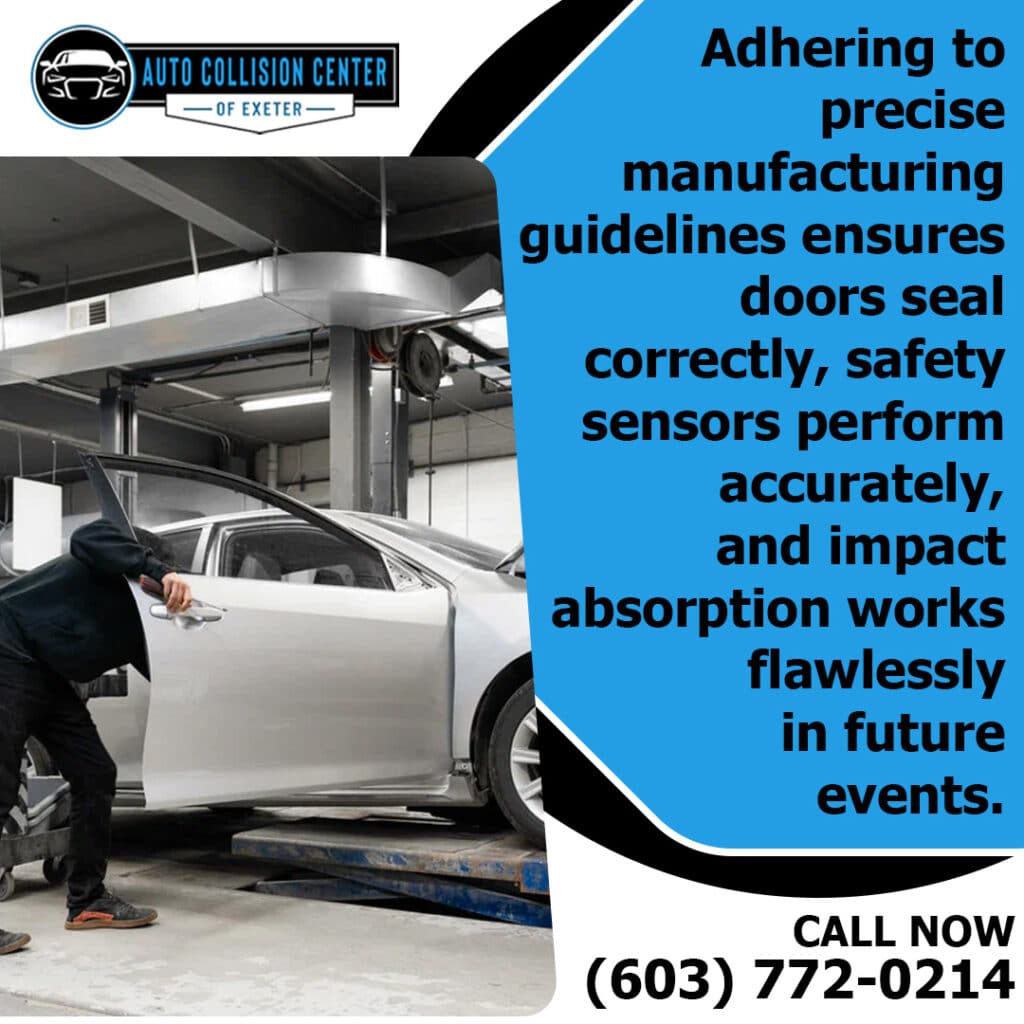
Manufacturers engineer every body panel and frame section to dimensional tolerances measured in millimeters. These tolerances are not aesthetic guidelines. They determine how your doors seal against water and wind. They set the precise angles at which your safety sensors must sit for accurate function. They govern how your vehicle’s structure distributes impact energy in a future collision.
When those tolerances are restored correctly, your vehicle performs as designed. When they are not, it may look fine while failing quietly over time. Water intrusion, corrosion, and sensor drift are common results.
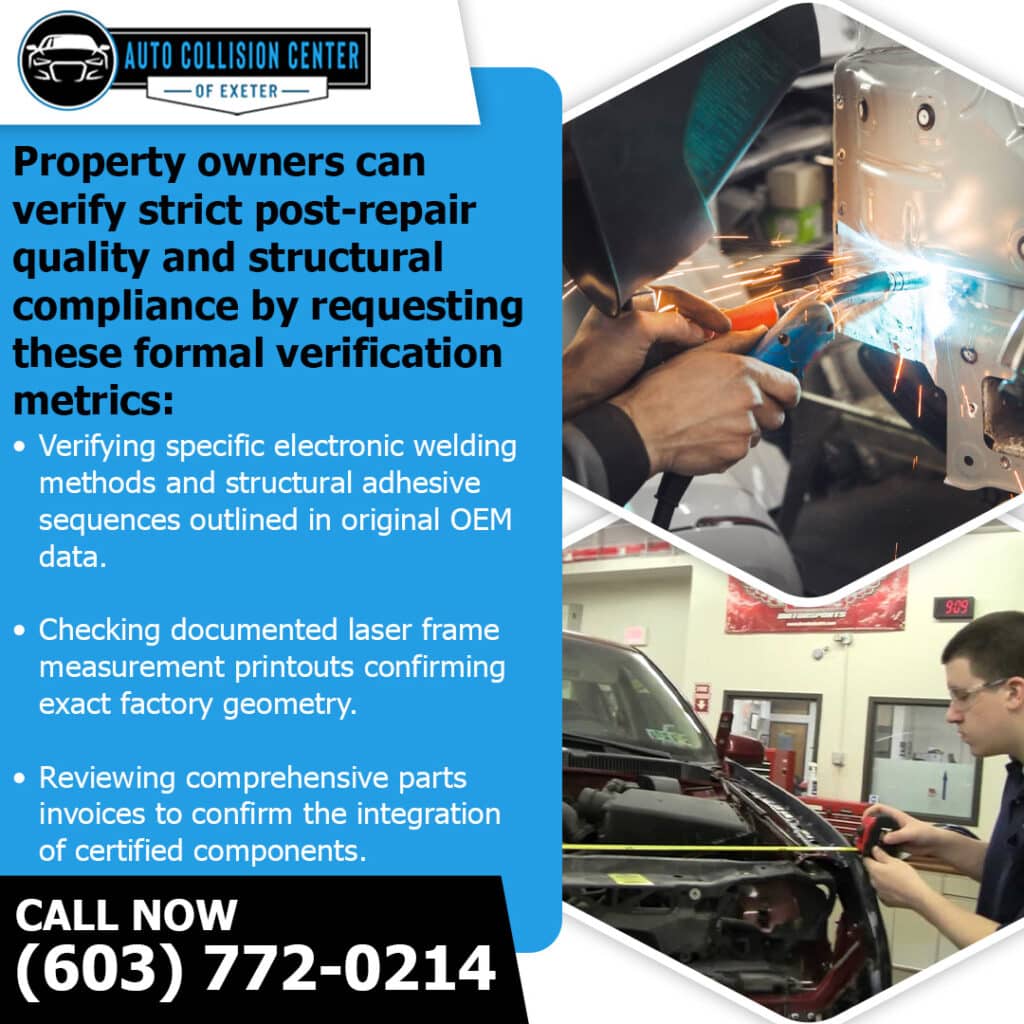
We verify structural geometry using Spanesi laser frame measuring equipment. This system checks frame and unibody dimensions against manufacturer specifications before the vehicle moves to paint. Our I-CAR Gold Class certification requires this step. That standard separates a confirmed result from a visual assumption.
How OEM Repair Procedures Protect More Than the Warranty
Most drivers know OEM parts are preferred. Fewer understand that OEM procedures matter just as much.
What OEM Procedures Specify
OEM procedures cover more than part selection. For each panel and structural joint, they specify:
- Weld location, count, and method
- Which joints use structural adhesive instead of welds
- Panel replacement sequences
- Torque specifications for fasteners at structural mounting points
These specifications exist because manufacturers crash-test their vehicles based on these exact parameters. A repair on your vehicle using correct parts but incorrect procedures may not perform as the manufacturer designed. The NHTSA‘s May 2024 FMVSS 127 Final Rule on automatic emergency braking systems for light vehicles projects that the standard will save at least 360 lives annually and prevent at least 24,000 non-fatal injuries each year. That depends on the underlying repair being correct.
I-CAR Gold Class certification requires our team to reference and follow OEM repair procedures on every job. That requirement is documented and audited. At Auto Collision Center of Exeter, it applies to all our auto body repairs in Exeter, NH. We use Prospot welding equipment, which supports the weld methods OEM procedures require.
What Happens When Procedures Are Not Followed
Deviations from OEM procedures are invisible in the finished repair. You cannot see a weld placed in the wrong location or a structural adhesive replaced by a weld. What you can see is paint cracking at a seam not built to carry that stress. Or a door gap widening as the body flexes. These signs appear months later.
Ask any shop: Do you use OEM documentation for each repair? We provide car body repair in Exeter, NH, following these standards, and this is traceable through documentation.
Why Parts Quality Determines How Long Your Repair Lasts
The parts we use affect more than the initial result. They determine how the repair holds up over time. Road salt and freeze-thaw cycles in New Hampshire accelerate any weakness in a poorly sourced panel.
OEM vs. Aftermarket: What the Difference Means in Practice
OEM parts are engineered and crash-tested to the same dimensional tolerances as the original component. Fit, finish, and structural performance are verified by the manufacturer.
High-quality aftermarket parts from approved suppliers can meet those tolerances. Our parts policy prioritizes OEM parts first. When aftermarket parts are used, we source only from trusted, established suppliers. We never use unverified sources like Amazon, eBay, or RockAuto.
Low-quality or unverified parts introduce dimensional variance that affects panel alignment and how long the repair holds.
How Parts Quality Affects Paint Adhesion and Long-Term Finish
A low-quality panel with surface dimensional variance creates inconsistent primer adhesion zones. Paint applied over an improperly fitted panel builds stress at seam edges. Over time, that stress on your vehicle produces edge lifting and color variation at panel seams. Clear coat cracking follows.
This is why a repair can look correct at delivery and show paint failure well before it should. Our warranty covers the repair. The durability of that warranty depends on the quality of the parts and the process behind it. Parts sourced to our policy standards feed directly into the RM paint system and downdraft booth process that follows.
The Role of Paint Refinishing in a Correct Repair
Paint is the most visible part of your body repair, but it is also a functional sealing system. When a panel on your vehicle is replaced or repaired, bare metal is exposed. Paint protects that metal from moisture and oxygen. A proper paint system applies primer, base coat, and clear coat in sequence, in a controlled environment. Each layer requires the right conditions to adhere and cure correctly.
Our heated downdraft paint booth controls temperature and filters airborne contaminants. In June, New Hampshire temperatures regularly reach the upper 70s and low 80s. Ambient heat affects how paint cures and how each coat must be timed before the next is applied. The controlled booth removes that variability.
We use an RM paint system with computerized color-matching. The system addresses color accuracy. The process it is part of addresses durability. Both are part of every car body repair in Exeter, NH that Auto Collision Center of Exeter delivers.
What a Correct Repair Looks Like From the Customer’s Side
Knowing a repair was done correctly is difficult without technical training. There are specific things to look for that indicate a shop is working to documented standards.
Documentation at intake. A quality shop photographs your vehicle before any work begins. We take around 100 photos of the interior and exterior. We also run a pre-scan using Snap-On and Bosch tools to document any fault codes before work starts.
Transparency during the repair. When disassembly reveals damage not visible at intake, we document it and contact you and your insurer before continuing. We handle the insurance paperwork so you can focus on getting back on the road.
Post-repair verification. After reassembly, we run a second diagnostic scan to confirm no fault codes remain. If your vehicle has ADAS features such as lane assist, automatic braking, or forward collision alerts, recalibration is coordinated through certified partners before delivery. These systems function only when sensors are correctly positioned after a repair. A road test evaluates braking, alignment, and system performance before delivery.
Warranty documentation at delivery. Our limited lifetime warranty covers all repairs and paint for as long as you own the vehicle. You receive that warranty in writing at delivery.
Bryan Dinger is our general manager. He brings more than twenty years of experience and Universal Technical Institute training. He oversees every repair at our 5,000 square foot facility.
Most of our customers are extremely satisfied with our services and never fail to recommend us. Here is a Google review by Dottie S., “Very professional and friendly, stress-free process from start to finish. When my car was finished, it looked like a brand new car inside and out, they did an excellent job. I would definitely recommend this shop to anyone looking to have work done to their vehicle.”
How Correct Auto Body Repair Protects Your Vehicle’s Long-Term Value
Vehicle history reports like Carfax and AutoCheck log collision claims. They do not log whether the repair was done correctly. Buyers and appraisers make that determination when they inspect the vehicle.
Appraisers check panel gap consistency, paint uniformity, and body line alignment as proxies for quality. A repair done to OEM tolerances passes. A cosmetic-only repair typically does not.
| What Appraisers Inspect | What It Indicates |
| Panel gap consistency | Frame and structural geometry |
| Paint uniformity at seam edges | Parts fit and paint process quality |
| Body line alignment | OEM tolerance adherence |
| Door and hood operation | Mounting point and hinge accuracy |
Our limited lifetime warranty applies as long as you own the vehicle. It is a written commitment that reflects confidence in our procedures and parts. A written warranty backs professional auto body repair. That verifiable commitment supports a vehicle’s documented value at resale.
Frequently Asked Questions
Does a car that looks fixed actually need additional repair?
Yes. Visible damage is often just the starting point. Pre-scans and disassembly reveal structural or system damage that does not show at the surface. We document all findings before any repair begins.
How do I know if my shop follows OEM repair procedures?
Ask directly whether the shop references OEM documentation for each repair. Estimating software is not the same as OEM procedure documentation. As an I-CAR Gold Class certified shop, we are required to follow OEM procedures on every vehicle we repair. We can walk you through exactly how we apply those standards on your car.
Is a limited lifetime warranty standard at all shops?
No. Coverage terms vary widely among shops. Our limited lifetime warranty covers all repairs and paint for as long as you own the vehicle. Parts carry the manufacturer’s warranty separately.
Schedule Your Auto Body Repair Consultation in Exeter, NH
A correctly repaired vehicle and one that only looks repaired are not the same. The difference is in the procedures, parts, measurements, and documentation.
Auto Collision Center of Exeter is a family-owned shop. We back every repair with documented OEM procedures and a lifetime warranty. If your vehicle has been in a collision, we can help. We want you to know the work was done right.
For vehicle owners of Exeter, NH, our auto body repair services can be relied on for quality. Contact us at (603) 772-0214 or accofexeter@gmail.com to schedule your free estimate. Our facility is at 58 Winter Street in Exeter, NH. We serve drivers throughout the Seacoast region with auto body repair.