
Synopsis
Minor collisions often cause hidden structural damage that affects safety, handling, and long-term vehicle value. Auto Collision Center of Exeter explains why visual damage is misleading and why professional evaluation matters.
Key Takeaways
- Low-speed impacts can shift frames, suspension, and safety systems
- Hidden damage develops before symptoms appear
- Proper inspection protects safety and resale value
You back into a post at 5 mph. The bumper has a crack. Your car drives fine. Everything seems okay. However, beneath that surface damage, your vehicle may have problems you cannot see.
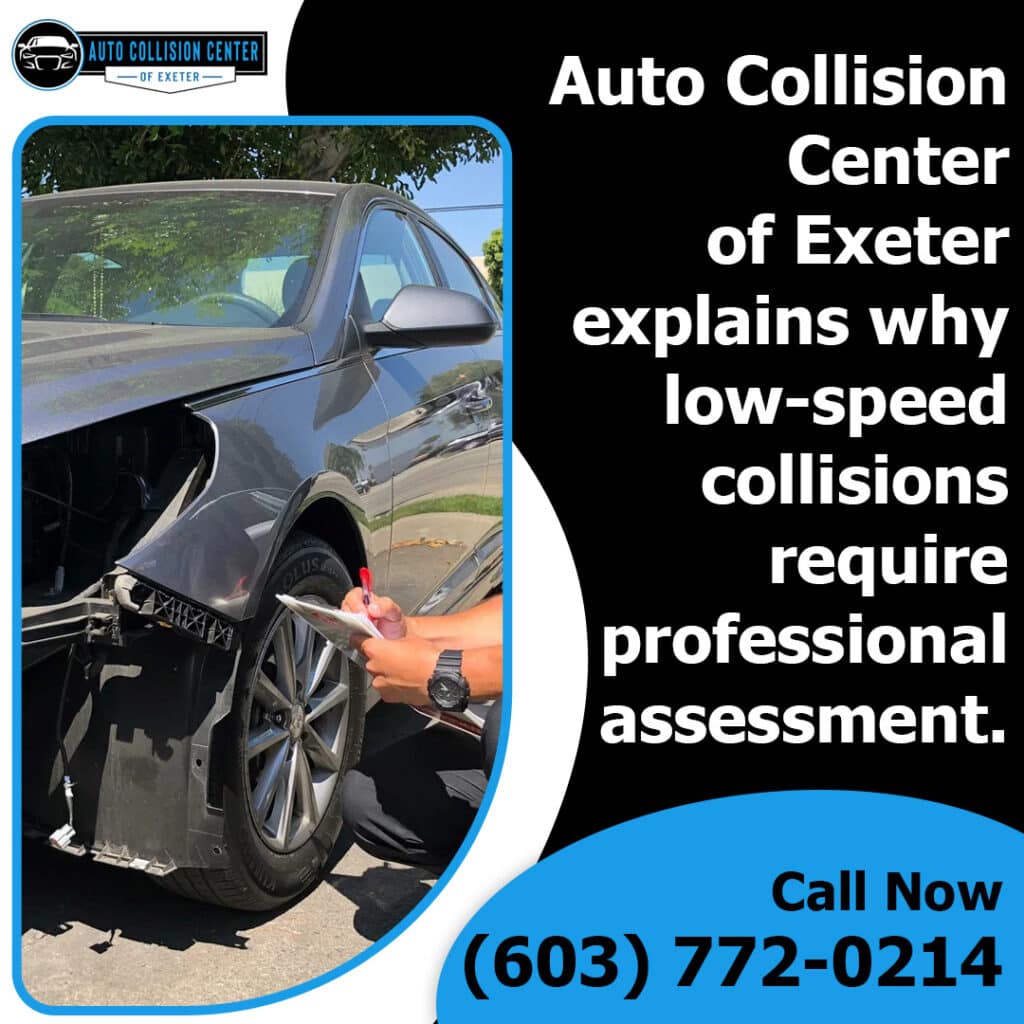
Modern vehicles are built with lightweight materials, crumple zones, and unibody structures that absorb and distribute collision forces. Even low-speed impacts (in the range of 5–10 mph) may deform energy-absorbing components, realign suspension or sensor mounts, or cause hidden issues not visible without inspection. These changes happen at the millimeter level. You won’t notice them until symptoms develop weeks or months later.
Throughout Exeter and New Hampshire’s Seacoast, tight parking areas and winter conditions create frequent low-speed impacts. Each one deserves professional evaluation. Hidden structural damage affects your safety regardless of how minor the accident appears.
Auto Collision Center of Exeter is a locally invested, family-run shop that delivers premium collision repair services in Exeter, NH. With 50 years of combined experience, we explain how minor collisions can cause damage and how professionals can detect and handle the damage properly. Our team works to protect your vehicle’s value and your family’s safety.
What Counts as a Minor Collision Today
Common Examples Drivers Assume Are “Minor”
People often dismiss certain accidents as too small to worry about. You reverse into a concrete barrier while parking. Another vehicle bumps your rear bumper at a red light. Your door panel gets scraped by a shopping cart. A fender bender occurs at 15 mph in stop-and-go traffic.
No airbags deploy. The vehicle starts and runs normally. The damage appears purely cosmetic. Your insurance deductible might be higher than the visible repair cost. Many drivers decide to skip repairs entirely. This decision overlooks how today’s vehicles manage collision forces.
Why Modern Vehicles React Differently to Impact
Current vehicles use aluminum panels, high-strength steel frames, and composite materials. These reduce vehicle weight for better gas mileage. They also change how structures respond when struck.
Engineers design crumple zones to absorb collision energy through controlled deformation. Unibody construction means the body and frame work as one integrated structure. When vehicles crash, kinetic energy travels through structural members. In many low-speed cases, this energy is primarily absorbed by bumpers and crumple zones, but in some collisions, it can transfer into deeper structures like subframes and sensor mounts.
Impact energy doesn’t stay localized at the contact point. It moves along frame rails, through mounting brackets, across welds and seams. This design protects people inside the vehicle. It also means damage assessment requires more than looking at surface panels.
How Impact Energy Travels Through a Vehicle
Collision forces follow pathways through your vehicle’s structure. When a bumper strikes something, kinetic energy transfers into connected components. A rear impact sends force through the bumper reinforcement, across the trunk floor, into rear frame sections, and toward suspension attachment points.
This explains why damage shows up far from the collision zone. A 10 mph front corner impact might crack the bumper cover. Inside, it may bend the radiator core support, move engine mounting brackets, or knock steering components out of alignment.
Energy moves along structural members based on vehicle engineering. Frame rails channel force toward the passenger cabin. Subframe assemblies spread it across suspension connection points. Welds and bonded joints experience stress that creates no visible damage but reduces structural strength.
You cannot see this force distribution without specialized equipment. A bent frame rail sits hidden behind plastic trim. A shifted suspension mount causes uneven tire wear that appears gradually. Only precision measuring tools detect these millimeter changes.
Hidden Structural Damage Caused by Minor Collisions
Unibody and Frame Alignment Shifts
Modern unibody structures require precise dimensions for proper function. Manufacturers define precise tolerances for structural geometry. Even small misalignments, measurable only with specialized tools, can indicate deviation from factory specifications and warrant professional inspection.
Frame misalignment doesn’t always create immediate problems. Your car might drive normally for several months. Issues emerge gradually:
- Tires develop wear patterns on the inner or outer edges
- Steering requires constant minor corrections to stay straight
- The vehicle drifts left or right when braking
- Handling feels uncertain during quick lane changes
By the time you notice these symptoms, other parts have worn prematurely from operating outside their designed geometry.
Suspension and Steering Geometry Changes
Suspension parts attach to the vehicle structure at specific locations and angles. Control arms, subframes, and mounting brackets maintain wheel positions that engineers calculated during vehicle design.
When collisions move these attachment points, suspension geometry changes:
- A control arm bracket shifted 5mm inward changes the wheel’s camber
- Altered camber creates uneven tire wear and affects cornering grip
- A bent subframe section changes caster and toe angles
- Changed toe angles make your vehicle pull steadily to one side
These geometry problems affect handling safety. They increase wear on ball joints, bushings, and tie rod ends. Your vehicle becomes less predictable during emergency maneuvers.
Compromised Crumple Zones
Vehicle crumple zones collapse in designed patterns during accidents. They absorb impact forces before those forces reach passengers. Front crumple zones deform on impact to slow vehicles more gradually, cutting forces on occupants and sudden speed drops that cause injuries, per NHTSA’s FMVSS 208 review.
Once any crumple zone section has compressed, it cannot work as designed in future accidents. The metal has already deformed. It won’t collapse in the correct sequence if struck again. This hidden problem affects occupant protection with no warning signs.
Sensor and Mounting Bracket Damage
Current safety systems use cameras, radar units, and ultrasonic sensors. These enable automatic emergency braking, lane keeping assist, and blind spot warnings. The sensors mount to brackets that bolt to the vehicle structure.
Minor collisions can shift these brackets by amounts too small to notice. Small shifts throw off sensor aim. Radar misalignment significantly shortens detection range, as analyzed in sensor studies.
Your safety features may seem to work normally. No warning lights illuminate on your dashboard. However, detection accuracy may be decreased. The system might miss hazards or activate when it shouldn’t, reducing your trust in the technology.
Why Structural Damage Is Easy to Miss Without Professional Assessment
Surface inspections show only visible problems. You see a dented bumper or scratched paint. You don’t see bent frame sections behind plastic covers. Our professional collision repair services in Exeter, NH, use diagnostic tools to find hidden damage.
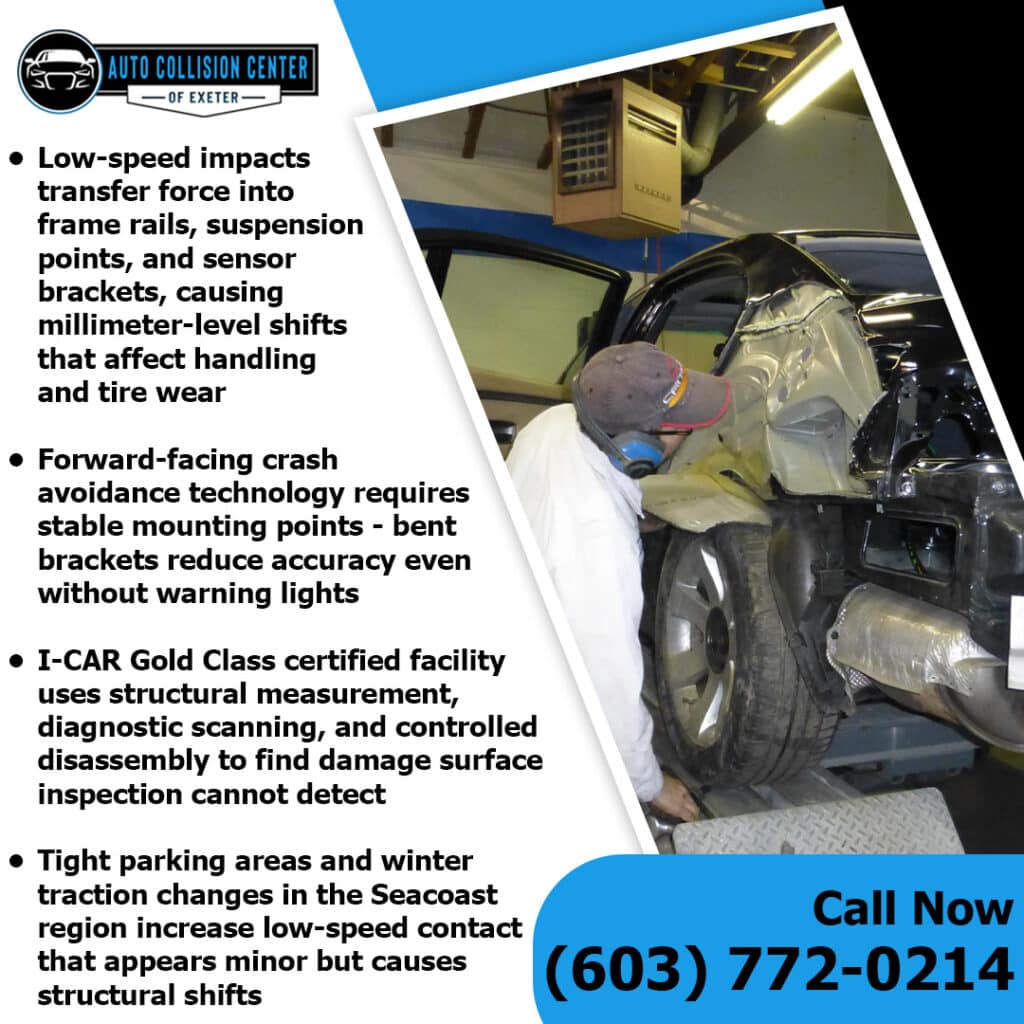
Our Spanesi computerized measuring systems compare your vehicle’s actual dimensions against factory specifications. Laser and electronic tools check hundreds of measurement points. These reveal frame bends, suspension misalignment, and body gaps measured in millimeters.
Without specialized equipment, damage stays hidden. It appears only when symptoms develop or when another accident reveals a compromised structure.
Complete assessment requires disassembly:
- Removing bumper covers reveals the mounting bracket and absorber condition
- Taking off fender liners exposes frame rail sections
- Checking under panels reveals subframe damage
- Using precision measuring confirms alignment status
Shops relying only on visual inspection miss safety-critical problems. This is why we follow systematic evaluation procedures for certified collision repair, regardless of apparent damage level.
Safety Risks of Driving With Undetected Structural Damage
Unrepaired structural problems create safety hazards. Your vehicle’s ability to protect people in future crashes decreases when crumple zones have already compressed. Frame misalignment means the structure cannot distribute impact forces the way engineers intended.
Airbag deployment systems depend on input from accelerometers and impact sensors. Structural changes outside design specifications can affect how these systems interpret crash dynamics, so professional inspection helps ensure airbag sensors and related systems are operating within designed parameters. Bags might deploy too late, too early, or fail to deploy at all.
Handling becomes unpredictable during emergencies. A vehicle with suspension misalignment doesn’t respond consistently to steering inputs. During sudden swerves to avoid obstacles, the car may pull unexpectedly. During hard braking, it might not track straight.
Effects accumulate over time. Parts operating outside design limits wear faster:
- Suspension bushings crack and deteriorate early
- Ball joints develop excess movement
- Steering connections loosen progressively
- Wheel bearings fail sooner than expected
This is why we use computerized measuring and diagnostic scanning to identify hidden problems. Our auto collision repair in Exeter, NH, addresses structural damage through complete assessment and proper repair procedures.
How Certified Collision Repair Identifies Structural Problems
Digital Scanning and Diagnostic Checks
We begin car collision repair with thorough diagnostic scanning. Pre-repair scans find fault codes stored in your vehicle’s computers. These codes identify sensor failures, airbag system issues, and safety feature problems caused by collision forces.
Diagnostic equipment connects to control modules throughout your vehicle. This process finds problems with no visible symptoms:
- Steering angle sensors showing out-of-range readings
- Radar calibration errors that affect automatic braking
- Suspension sensors reporting incorrect positions
- Airbag components needing replacement
Post-repair scans confirm all systems work correctly after repairs finish. This verification step proves safety system restoration.
Frame and Unibody Measuring Systems
Laser measuring equipment and computerized alignment systems check structural integrity precisely. These tools measure hundreds of points across the vehicle structure. Technicians compare actual readings to factory specifications.
Manufacturers provide exact specifications. Any measurement outside acceptable limits indicates structural damage needing correction. We use Spanesi frame measuring and straightening systems. These apply controlled force to restore correct alignment while following manufacturer procedures.
Frame straightening needs specialized training. We understand metal properties, heat effects, and force directions. Incorrect straightening can weaken the structure or create new stress concentrations.
OEM Repair Procedures and Documentation
Every vehicle maker publishes collision repair procedures. These differ by make, model, and year because structural designs vary. Following documented procedures protects structural strength and keeps warranty coverage valid.
We access manufacturer repair information for each vehicle. These procedures specify:
- Which parts must be replaced instead of repaired
- Where structural reinforcements are required
- How to apply structural adhesives properly
- Correct welding methods for different materials
Skipping these procedures compromises safety. It may also cancel warranty coverage for safety-related systems.
Why Minor Collision Repairs Should Never Be Rushed
Proper car collision repair requires adequate time for thorough assessment and restoration. Complete evaluation involves disassembly, precision measurement, structural repair, and system verification. Each step matters for long-term vehicle safety and performance.
Incomplete evaluations lead to missed damage. Shops not performing frame measurements may overlook alignment problems. Skipping diagnostic scans means missing sensor damage. These shortcuts save time initially but create problems that cost more to fix later.
Long-term results of rushed repairs include:
- Lower vehicle resale value from incomplete repair documentation
- Continuing mechanical problems from operating with misalignment
- Reduced safety from weakened structural strength
- Extra repair costs as hidden damage causes new failures
Auto Collision Center of Exeter invests the time needed to evaluate damage completely and repair it correctly. This approach protects your safety and your vehicle investment through certified collision repair standards.
What Drivers Should Know About Local Driving Conditions in Exeter, NH
Exeter’s downtown has narrow streets, angled parking spots, and heavy foot traffic. These conditions increase low-speed collision chances. Water Street’s tight parking areas see regular fender benders. Route 108 intersections experience rear-end impacts during rush periods.
Winter weather adds difficulty. Icy parking lots reduce vehicle control. Snow banks hide curbs and obstacles. Even skilled drivers face situations where minor impacts cannot be avoided.
Local patterns mean seemingly minor collisions happen often. Each incident needs professional evaluation. Hidden damage affects safety regardless of apparent severity.
New Hampshire state inspections check visible components. Inspectors examine brakes, lights, and steering function. They cannot detect hidden frame damage or compressed crumple zones. Only certified collision repair with precision equipment finds these problems.
How Professional Auto Collision Repair Protects Vehicle Value and Safety
Correct structural repairs maintain vehicle strength and resale value. Documented repairs following manufacturer procedures prove restoration was done properly. This documentation matters when selling your vehicle or making future insurance claims.
Long-term vehicle ownership depends on structural integrity. Vehicles with unrepaired frame damage develop cascading failures:
- Suspension parts wear out faster than their normal service life
- Tires need frequent replacement due to alignment problems
- Handling deterioration makes driving less safe
- Reduced resale value from accident history issues
Our collision repair services in Exeter, NH, address current damage and prevent future problems. With precise repairs, we restore factory specifications. Our shop coordinates safety system calibration when needed. Your vehicle value stays protected through proper documentation and our Limited Lifetime Warranty.
We emphasize thorough evaluation and correct repair methods. Your safety depends on structural integrity, which you cannot see or check without specialized equipment.
When a Minor Collision Deserves Professional Attention, Call Auto Collision Center of Exeter
Surface appearance doesn’t show the structural condition. A vehicle looking undamaged after a parking lot accident may have hidden problems. Frame bends, compressed crumple zones, and moved suspension mounts affect safety with no visible signs.
Professional evaluation after any collision protects both safety and investment. Auto Collision Center of Exeter provides a complete assessment using computerized measuring equipment, diagnostic scanning, and manufacturer-specific repair procedures.
Our I-CAR Gold Class certified shop has the tools and training to find hidden damage. We coordinate with all insurance companies and provide detailed repair records. You receive consistent updates throughout the repair process.
Are you looking at options for affordable collision repair in Exeter, NH? Contact us at (603) 772-0214 or accofexeter@gmail.com for a complete evaluation. We work with insurance companies to make the process smooth. Your vehicle needs proper professional attention after any collision, regardless of how minor it appears. Schedule your assessment today.