Synopsis
Collision repair has changed as much as the vehicles themselves. Auto Collision Center of Exeter explains what makes late-model collision repair different, and what those differences mean for you as a vehicle owner.
Key Takeaways
- Late-model vehicles use high-strength steel, aluminum, and structural adhesives that require manufacturer-specific repair methods
- Active safety sensors can be displaced or damaged in impacts that leave no visible exterior damage
- OEM repair procedures, not general industry practices, govern structural bonding, weld counts, and part selection on newer vehicles
- ADAS recalibration is a required post-repair step on most late-model vehicles, not an optional one
- Proper documentation of repairs protects resale value; improper or incomplete repairs reduce it
- Only about 20% of U.S. shops hold I-CAR Gold Class certification, a meaningful distinction when your vehicle is newer and more complex
Collision repair looks straightforward from the outside. A damaged vehicle goes into a shop, gets fixed, and comes back looking the way it did before the accident. For decades, that description was mostly accurate. The materials were predictable, the repair methods were well established, and a skilled technician with the right tools could restore most vehicles reliably.
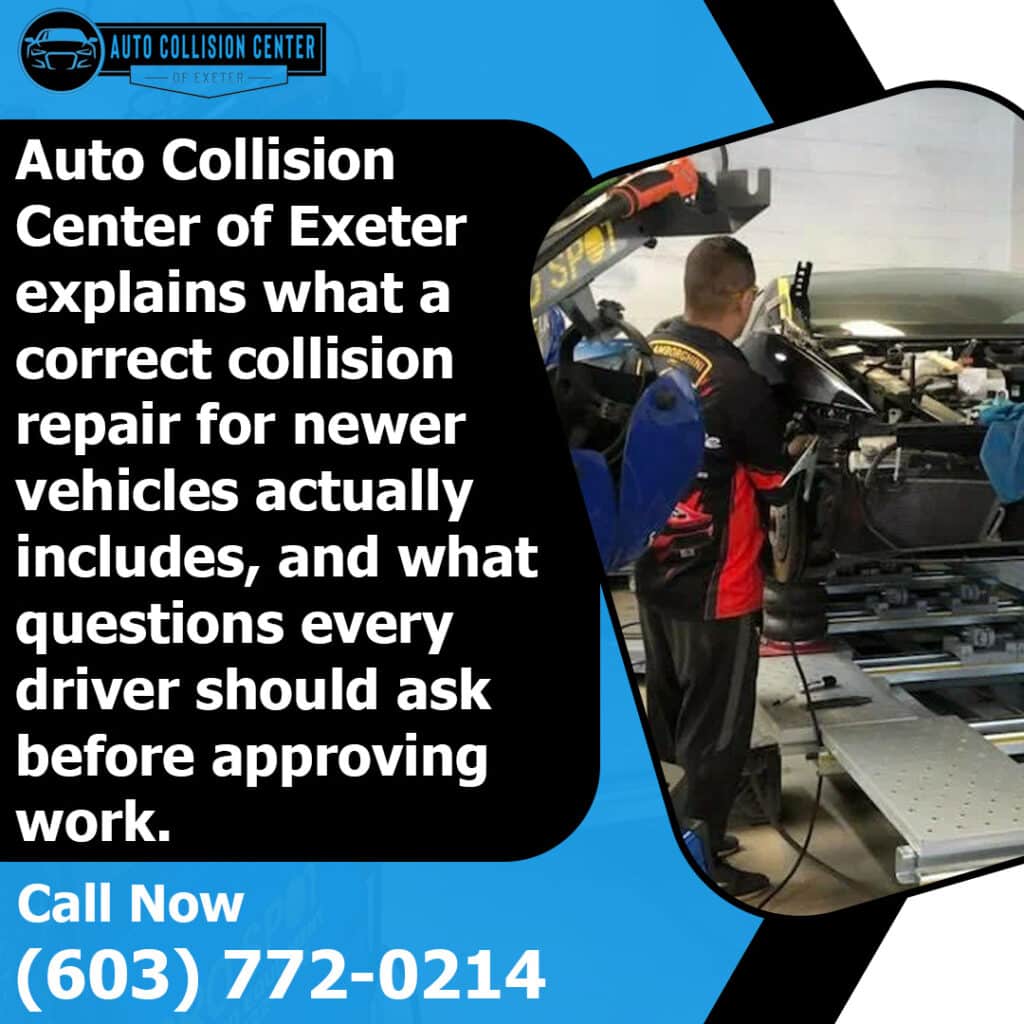
That is no longer the full picture. Vehicles built over the last ten years are structurally and electronically different from anything that came before them. Knowing what proper late-model collision repair involves is practical information. It affects your safety on the road, your vehicle’s performance, and its long-term value. At Auto Collision Center of Exeter, we follow manufacturer-specific repair procedures on every job. We cover what makes car collision repair different on newer vehicles, why those differences matter, and what a correctly performed repair actually includes.
What Has Changed About How Newer Vehicles Are Built
Vehicles arriving at a certified collision repair shop today present challenges that simply did not exist a decade ago, starting with how they are built. Automakers shifted toward mixed-material builds, combining high-strength steel, aluminum alloys, and polymer composites in a single body structure to meet stricter crash-test standards while reducing weight.
That shift produced vehicles that are structurally stronger and considerably more repair-sensitive than anything built before them.
High-Strength Steel Behaves Differently Under Repair
Mild steel, the material most older vehicles were built from, is forgiving during body repairs. It bends, stretches, and welds with relative ease. High-strength steel (HSS) and ultra-high-strength steel (UHSS) do not behave the same way.
Heat from standard welding reduces the tensile strength of HSS and UHSS. A weld placed outside the OEM-specified location, or applied at the wrong heat setting, can weaken the very area it is meant to repair. The joint holds visually but performs below its original structural specification in a subsequent crash.
Our technicians use Prospot welding equipment and follow OEM and I-CAR documented procedures on auto collision repair in Exeter, NH. Weld location, count, and method are not judgment calls on newer vehicles. They are specified requirements.
Structural Adhesives and Mixed-Material Joints
Structural adhesives have replaced or supplemented traditional welds in many body joints on newer vehicles. These adhesives are engineered to transfer specific loads across bonded surfaces. Substituting a weld in an adhesive-bonded joint alters how that structure distributes impact energy during a collision.
The core challenge with mixed-material construction is that no single repair approach applies across all vehicles. Each make and model has its own manufacturer-documented procedure. A method acceptable on a 2014 vehicle may be entirely wrong for a 2021 version of the same model.
We reference OEM repair procedures as the baseline on every job, not as an optional upgrade. I-CAR Gold Class certification requires our team to stay current as those procedures evolve with each new model year.
Why Active Safety Systems Change the Repair Equation
Most vehicles built after 2016 carry some form of ADAS (Advanced Driver Assistance Systems). By model year 2023, virtually all new vehicles sold in the U.S. were equipped with automatic emergency braking and forward collision warning as standard features, the result of a voluntary industry commitment brokered by the IIHS and NHTSA.
These systems rely on sensors and cameras mounted in locations that are directly involved in collision damage: front bumper covers, rear fascias, windshields, door mirrors, and A-pillars.
What Collision Damage Does to ADAS Sensors
A sensor does not need to be physically broken to stop working correctly. Displacement of a few millimeters changes the detection angle of a radar unit. A windshield replacement without camera recalibration leaves the forward-facing camera pointing at the wrong reference point. A bumper cover removed during repair and reinstalled slightly out of position can shift the radar unit behind it outside its operational parameters.
None of these failures produces visible damage. None of them triggers immediate warning lights in every case. A driver can leave a repair shop with disabled or degraded collision avoidance without knowing it.
Research puts the stakes plainly:
| ADAS System Combination | Reduction in Rear-End Crash Rate |
| Forward Collision Warning (FCW) only | 27% fewer rear-end crash involvements |
| Automatic Emergency Braking (AEB) only | 43% fewer rear-end crashes |
| FCW + AEB combined | 50% fewer crashes; 56% fewer injury crashes |
These are the safety margins your vehicle was designed to provide. They depend entirely on sensors working within manufacturer specifications after every repair.
How We Handle ADAS at Our Shop
We run a full pre-repair diagnostic scan on every vehicle using Snap-On and Bosch diagnostic equipment. This scan documents active fault codes before any disassembly begins, protecting you from disputes about pre-existing conditions and directing our repair plan accurately from the start.
After repairs are complete, a post-repair scan confirms that no new codes were introduced and that the systems we touched are functioning correctly. When the scope of repair requires ADAS recalibration, whether for a bumper replacement, windshield replacement by our glass partner, or any structural work near sensor mounting locations, that calibration is coordinated through certified ADAS calibration partners using manufacturer-specific equipment before the vehicle is returned to you.
What OEM Procedures Actually Govern on a Late-Model Repair
The term “OEM procedures” gets used frequently in certified collision repair, but few shops explain what it actually requires on a late-model vehicle. It covers a specific and extensive set of requirements that go well beyond general repair practices.
Weld Placement, Count, and Method
Manufacturer repair documentation specifies exact weld locations, the number of spot welds required, and, in many cases, the specific welding equipment type. Structural strength in a unibody vehicle depends on load-transfer paths engineered through specific joint locations. Adding welds outside those locations or reducing the specified count changes how the structure performs in a crash.
We use Prospot welding equipment and follow OEM and I-CAR documented procedures on every structural repair. The goal is not just a repair that holds. It is a repair that performs the same way the factory intended.
Adhesive and Sealant Application
Many late-model body panels are bonded with structural adhesives rather than welded, or use adhesive-plus-weld combinations. The adhesive type, coverage area, and cure process are all specified in OEM documentation. Using a substitute adhesive, even a high-quality one, may not meet the load-transfer requirements of that joint, which compromises the structure’s ability to protect occupants in a subsequent collision.
Heat-Affected Zones and Replacement Requirements
Some structural components on newer vehicles cannot be straightened after collision damage. OEM procedures often specify replacement rather than repair for certain high-strength steel members because heat or deformation permanently changes the material’s mechanical properties. Straightening a component that requires replacement restores its appearance, but not its strength, leaving the vehicle vulnerable to catastrophic failure in a future crash.
Frame Measuring on Late-Model Unibody Vehicles
Most vehicles built since the early 2000s use unibody construction, meaning the body and structural frame are a single integrated assembly. In a late-model vehicle, that structure is built to tolerances measured in millimeters, and its geometry directly affects how the vehicle handles and how it performs in a subsequent collision.
Frame damage in a unibody vehicle does not always produce obvious indicators. The vehicle may drive reasonably well while carrying frame geometry outside manufacturer tolerances, yet multiple problems can emerge: tires wear unevenly, steering requires constant correction, and airbag deployment timing may be compromised if sensor mounting positions have shifted.
We use Spanesi laser frame measuring equipment on every structural repair. The result is a documented measurement report, not a visual estimate, that confirms the vehicle’s geometry was restored to within manufacturer specifications. That report becomes part of the collision repair services record and supports insurance documentation of any supplemental damage discovered during the repair process.
How Repair Quality Affects Resale Value on Newer Vehicles
According to the Insurance Information Institute, a vehicle that has been in a major accident generally carries lower resale value than the same vehicle without that history, even when repairs are fully completed. This is what the insurance and automotive industries recognize as diminished value, a real and permanent reduction in market worth that appears on vehicle history reports.
What determines how much value a vehicle retains after a car collision repair comes down to three things:
- Whether repairs followed OEM procedures. A vehicle repaired to manufacturer specifications can be documented as such. That documentation matters to buyers and dealerships evaluating trade-in value.
- Whether parts were OEM or high-quality approved alternatives. OEM parts match factory fit and sensor compatibility exactly. When an insurance policy requires aftermarket components, we source only from established, vetted manufacturers, never from unverified online suppliers.
- Whether the repair record is complete and verifiable. Incomplete records reduce buyer confidence. A documented repair trail, including pre-scan, measurement report, parts sourcing, and post-scan, supports the case that the vehicle was restored correctly.
We follow all three of these practices on every repair. Our limited lifetime warranty, which covers all repairs and paint work for as long as you own your vehicle, reflects our confidence in that standard.
What to Ask Any Shop Before Authorizing Repairs on a Newer Vehicle
These questions apply whether you bring your vehicle to us for collision repair services in Exeter, NH, or anywhere else. The answers tell you whether a shop is equipped and trained to handle a late-model repair correctly:
- Does the shop reference OEM repair documentation for your specific make and model?
- Will a pre-repair diagnostic scan be completed before disassembly begins?
- Does the shop hold I-CAR Gold Class certification? Only about 20% of U.S. shops do.
- How is ADAS recalibration handled, and by whom?
- Will the repair include a post-repair scan to verify system status?
- Are parts sourced from OEM suppliers or vetted aftermarket manufacturers?
A shop confident in its process will answer all of these directly.
How Our Shop Approaches Late-Model Collision Repair
Bryan Dinger, our general manager, brings more than twenty years of experience in auto collision repair and formal training from the Universal Technical Institute. Under his oversight, our team follows a structured process designed specifically for the complexity that newer vehicles demand.
Here is how a late-model repair moves through our facility at 58 Winter Street:
- Documentation and pre-scan: Over 100 photos are taken at check-in. A full diagnostic pre-scan using Snap-On and Bosch diagnostic tools captures all active fault codes before any disassembly.
- Disassembly and measurement: Hidden damage is assessed after panel removal. Spanesi laser measuring documents frame geometry against manufacturer tolerances. Supplemental damage found at this stage is submitted to your insurer for approval before repairs proceed.
- Structural repair: Prospot welding equipment and OEM-specified procedures guide all metal work. Structural adhesives are applied per manufacturer documentation. All parts are pre-fitted before the vehicle moves to refinishing.
- Refinishing: Our RM paint system and RM computerized color-matching camera analyze your vehicle’s current color before application. Primer, base coat, and clear coat are applied in our downdraft, heated paint booth.
- Post-scan and ADAS coordination: After reassembly, a full post-repair scan confirms system status. ADAS recalibration is coordinated through certified partners when required by the repair scope.
- Road test: Every vehicle is test-driven for braking, steering response, and system performance before delivery.
Our DRP partnerships with State Farm, Geico, and Amica mean we work directly within their established claims processes, so your repair moves efficiently without sacrificing the procedures your vehicle needs.
Non-Negotiable Collision Repair Standards at Auto Collision Center of Exeter
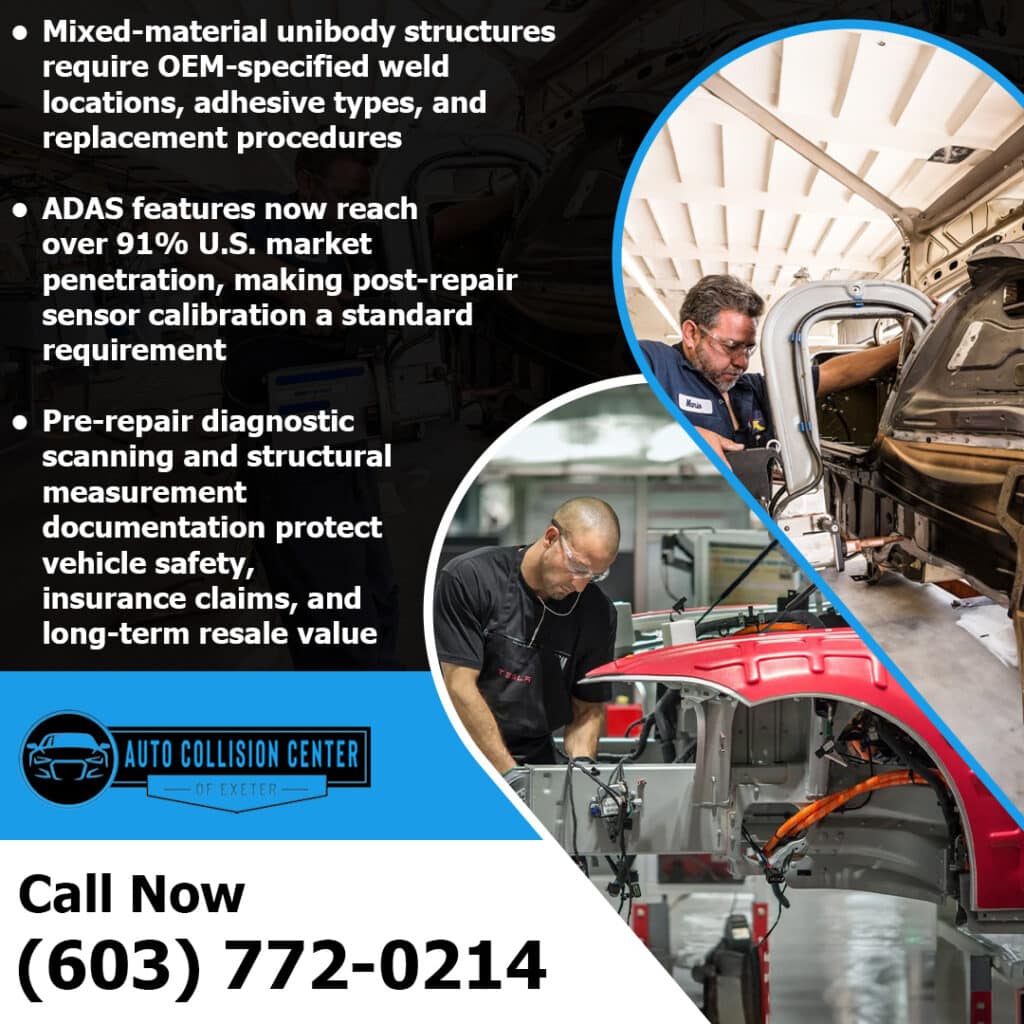
The difference between a correct repair and an incorrect one on a late-model vehicle is not always visible. It lives in the weld count, the adhesive coverage, the frame measurement, the post-repair scan, and the sensor calibration. These are not extras. They are the repair.
Drivers in Exeter, NH, and nearby Seacoast communities, including North Hampton, Portsmouth, and surrounding areas, deserve certified collision repair from a shop that treats those standards as the baseline, not the exception.
Are you looking for affordable collision repair that does not compromise your safety? Contact Auto Collision Center of Exeter at (603) 772-0214 or email accofexeter@gmail.com to schedule your estimate. Visit us at 58 Winter Street, Exeter, NH 03833. Every repair we perform is backed by our limited lifetime warranty for as long as you own your vehicle.