Synopsis
Collision damage shifts a vehicle’s structural geometry in ways that affect steering, braking, tire wear, and crash protection, often without obvious symptoms at first. Professional auto body repair restores structural alignment through precise frame measurement, controlled correction, and verified post-repair confirmation. Auto Collision Center of Exeter follows manufacturer procedures to return each vehicle’s structure to factory specifications before it leaves our facility.
Key Takeaways
- Structural alignment governs steering accuracy, braking response, tire life, and crash performance
- Collision forces can shift frame geometry even when exterior damage looks minor
- Unaddressed misalignment worsens with every mile driven
- ADAS safety systems require correct structural positioning to function as designed
- OEM-standard structural repairs, properly documented, protect both safety and resale value
Structural misalignment is one of the most commonly overlooked consequences of collision damage and one of the most consequential. When it goes unaddressed, it does not stay the same. Every mile driven on misaligned geometry adds wear to tires, stresses suspension components, and can compromise the ADAS safety systems that late-model vehicles depend on.
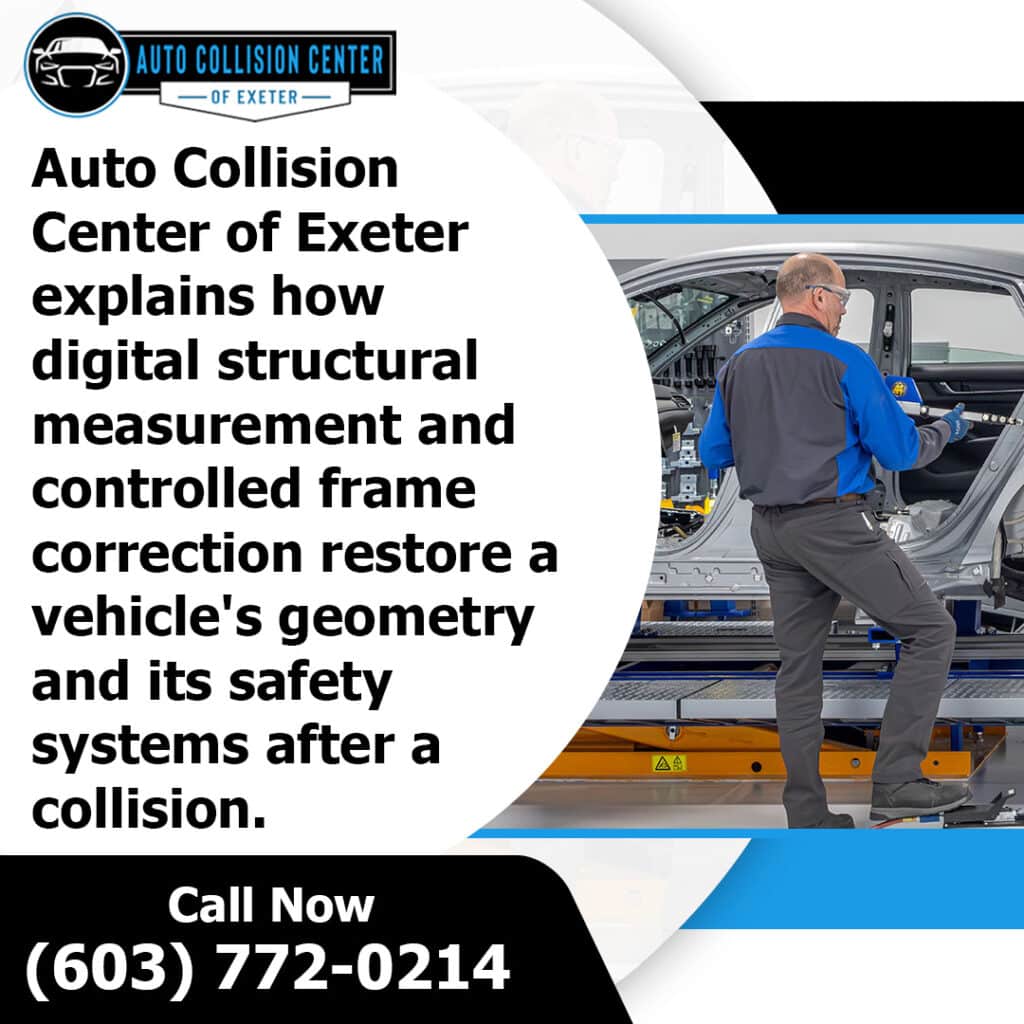
At Auto Collision Center of Exeter, we have seen this in our decades of combined experience. Drivers arrive after what they describe as a minor impact: a parking lot scrape, a slide into a curb during a New Hampshire winter, a low-speed rear-end collision, and our frame measurements tell a different story. Identifying the full scope of structural displacement, correcting it to factory specifications, and verifying the result before the vehicle leaves our facility is central to how we approach every repair.
Understanding what structural alignment is, how collisions compromise it, and what professional auto body repair does to restore it helps you make better decisions about your vehicle after any collision, regardless of how the outside looks.
Why Structural Alignment Is Central to Vehicle Safety
How Manufacturers Engineer Structural Geometry
Structural alignment is the precise spatial relationship between a vehicle’s frame reference points, suspension mounting locations, and body attachment positions; all defined to exact manufacturer tolerances. These tolerances exist because every handling, braking, and crash protection characteristic the vehicle was designed to deliver depends on them.
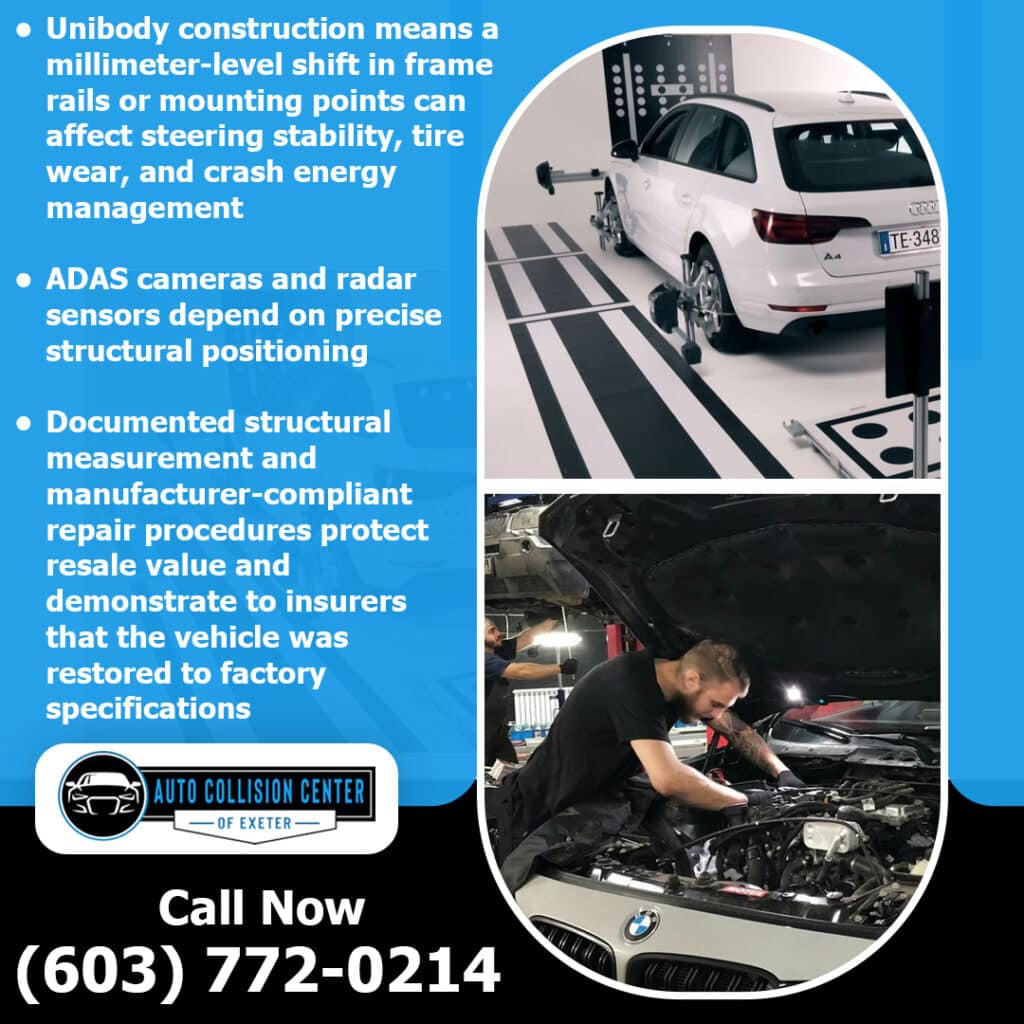
Most late-model passenger vehicles use a unibody construction, where the floor pan, rocker panels, pillars, and firewall are welded into one continuous load-bearing structure. Larger trucks and some SUVs use a body-on-frame design with a separate chassis. In either case, engineers specify exact three-dimensional measurements for every structural reference point. Acceptable variation is often just a few millimeters.
Those tight tolerances are not arbitrary. They reflect how the vehicle is designed to distribute weight across all four wheels, guide suspension geometry through its travel range, and manage crash energy through engineered crumple sequences. When any reference point shifts out of tolerance, the effects cascade through every connected system.
What Collision Forces Do to Frame Geometry
The challenge is that these changes are often invisible from the outside. The energy has to go somewhere. And it does, by compressing, bending, or displacing structural components.
Common geometry changes after a collision include:
- Frame rail shortening or lateral displacement along the vehicle’s length
- Firewall or floor pan twisting that shifts body mounting points out of plane
- Suspension mounting points rotating or moving inward relative to the factory position
- Structural crossmembers bending, which changes the reference datum for all four corners
A vehicle with a compressed front rail and shifted suspension mounting point may show nothing more than a cracked bumper cover and a bent fascia bracket. That does not mean the damage stops there.
When Small Geometry Changes Create Large Consequences
Consider what a 5mm shift in a front suspension mounting point actually means on the road. That shift changes the camber angle at which the tire contacts the pavement. It alters the caster, which affects straight-line stability and steering return-to-center feel. It changes the scrub radius, which influences brake pull. None of these effects announces itself with a warning light. They show up as gradual tire wear, a persistent pull to one side, or a steering wheel that no longer sits centered; symptoms that drivers often attribute to other causes.
This is why professional auto body repair in Exeter, NH, at Auto Collision Center of Exeter starts with measurement, not assumptions. What the vehicle tells us with its instruments tells a more accurate story than what the exterior shows.
Recognizing Structural Misalignment After a Collision
Driving Behavior That Signals a Problem
Some structural misalignment reveals itself through how a vehicle behaves on the road. Watch for these specific changes after a collision:
- Consistent pull to one side on a flat, straight road, not attributable to crosswinds or a crowned surface
- Steering wheel sitting off-center at highway speed when traveling in a straight line
- Uneven braking response, where the vehicle pulls left or right under firm brake application
- Accelerated or uneven tire wear appearing within weeks of the collision
These symptoms do not always appear right away. Misalignment-related changes often build gradually as worn components amplify the underlying geometry error over time.
Visual Indicators Worth Noting
You do not need measuring equipment to notice early warning signs. Check these specific areas:
- Uneven panel gaps between the hood, fenders, and doors–particularly gaps that are wider on one side–suggest the structure behind has shifted
- Doors or the trunk lid that require extra force to close or no longer sit flush with surrounding body panels
- Bumper or fender positions that appear higher, lower, or angled compared to the matching component on the opposite side
None of these signs alone confirms structural misalignment. Any of these signs that appear after a collision justify a professional structural assessment.
How Professional Auto Body Repair Restores Structural Alignment
Measurement Before Anything Else
Structural repair starts with establishing exactly where every reference point is relative to where it should be. Our Spanesi frame measuring system maps the vehicle’s structural geometry against manufacturer data, identifying each point’s position in three dimensions. This is not a visual estimate. It is a precise, documented baseline that guides every correction that follows and supports the insurance documentation for the repair.
Measurement also happens continuously during correction. As our technicians apply corrective force using the Spanesi frame rack, the measuring system tracks changes in real time. Technicians adjust direction, sequence, and force based on live data, not guesswork. When every reference point returns to within manufacturer tolerances, the correction is confirmed, not assumed.
Finding What the Surface Does Not Show
Before structural correction begins, the damaged area is disassembled. Panels, brackets, and components come off to expose what lies behind them. This step regularly reveals damage that no surface inspection could detect: bent inner brackets, distorted reinforcements, compressed frame sections hidden behind wheel wells, and cracked weld joints at load path transitions.
What the disassembly exposes shapes the entire repair plan. Technicians and estimators review all findings together, add any supplemental damage to the estimate, and submit the complete scope to the insurance carrier or the customer for approval before ordering parts or beginning structural work.
Correcting the Structure and Replacing What Cannot Be Corrected
Some structural components can be measured back to specification using the frame rack. Others cannot. Sections that have been severely compressed, kinked, or cracked at weld joints lose their engineering properties in the damaged area. Straightening them does not restore those properties. Those sections are replaced.
Our technicians use Prospot welding equipment and follow OEM-specified procedures for all structural joining and replacement work. Part sourcing follows manufacturer preference: OEM components when the repair plan allows, and trusted high-quality aftermarket alternatives when required. We do not use low-quality parts from unverified suppliers for car body repair in Exeter, NH, regardless of cost pressure.
Post-Repair Verification
After structural correction and reassembly, a final diagnostic scan confirms that all vehicle systems are operating correctly and that no fault codes remain unresolved. If any Advanced Driver Assistance Systems, such as automatic emergency braking, lane departure warning, or blind spot detection, require recalibration following structural repairs, that step is coordinated before the vehicle is returned to the driver.
This final verification is not optional. It is what confirms the vehicle is road-ready, not just visually complete.
Structural Alignment and ADAS: A Critical Connection
Modern vehicles rely on ADAS sensors, cameras, radar units, and ultrasonic detectors, mounted at precise positions and angles relative to the vehicle’s structural geometry. When that geometry shifts, sensor detection zones shift with it. A camera calibrated to read lane markings may look slightly off-axis. A radar unit may monitor areas outside its intended coverage pattern.
The PARTS program, the largest government-automaker study of ADAS effectiveness to date, covering approximately 98 million vehicles, found that automatic emergency braking continues to cut rear-end crashes in half. These systems only deliver protection when operating on a correctly aligned structure.
| ADAS Technology | Documented Crash Reduction |
| Forward Collision Warning (FCW) only | ~16% (13 – 20%) reduction in front-to-rear crashes |
| Automatic Emergency Braking (AEB) | ~50% reduction in front-to-rear crashes |
How Structural Repairs Affect Long-Term Vehicle Value
Structural damage has the most lasting impact on what a vehicle is worth after a collision. Vehicles repaired after crashes often experience diminished value due to accident history on record, with severity multipliers in the standard 17c formula (used by many U.S. insurers) reaching 1.0 for severe structural damage, starting from a 10% base loss of pre-accident market value.
The repair record is what separates a vehicle that holds its value from one that carries a second layer of depreciation. Documentation showing that OEM procedures were followed, that verified measuring equipment confirmed the structural correction, and that a post-repair scan confirmed system function gives future buyers and insurers a factual basis for confidence in the repair.
Repairs completed without proper documentation or that relied on non-standard methods leave a gap in the record. Buyers and appraisers treat that gap as uncertainty, and uncertainty reduces what they offer.
What Our Team Brings to Structural Auto Body Repair
At Auto Collision Center of Exeter, structural alignment repair is built into how we handle every collision job. Our I-CAR Gold Class certification means the entire team meets ongoing training requirements covering current vehicle construction, manufacturer repair procedures, and safety system integration. Individual technicians hold I-CAR Platinum certification.
Bryan Dinger, our general manager, brings more than twenty years of auto collision repair experience to every vehicle that enters our 5,000 sq ft facility. His background includes formal training from the Universal Technical Institute and hands-on leadership at collision repair facilities across the New Hampshire seacoast. Under his direction, our team follows a consistent, documented process: measure first, correct to specification, verify before delivery.
Our team carries more than 50 years of combined experience in collision repair and auto body repair services. As a family-owned shop, we drive the same roads our customers do. That is a direct reason why structural accuracy matters on every vehicle we repair.
Steps to Take After a Collision That May Have Affected Alignment
If your vehicle has been in a collision, even a low-speed one, these steps protect both your safety and your repair options:
- Document the damage immediately. Photograph panel gaps, misaligned body components, and any visible deformation from multiple angles before the vehicle is moved or cleaned.
- Note any changes in how the vehicle drives. Pulling, off-center steering, vibration, or uneven braking that was not present before the collision should be reported to the repair facility. These details help technicians prioritize the inspection.
- Schedule a structural inspection before putting more miles on the vehicle. Driving on misaligned geometry accelerates wear on tires, suspension components, and steering parts.
- Bring your insurance information. A certified repair facility will coordinate directly with your insurer, handle supplement documentation when disassembly reveals additional damage, and keep you informed throughout.
Professional Auto Body Repair That Restores Structural Alignment
Structural alignment is not a detail of collision repair. It is the foundation of it. Your vehicle’s frame geometry determines how it steers, stops, wears its tires, and protects occupants in a future crash. When a collision shifts that geometry, proper auto body repair restores it through measurement, controlled correction, and verified confirmation, not visual approximation.
If you’re a resident of Exeter, NH, auto body services are available at Auto Collision Center of Exeter. You can call (603) 772-0214 or email accofexeter@gmail.com. Visit us at 58 Winter Street in Exeter, NH. Our certified team handles the inspection, insurance coordination, and every step of the structural repair process, so you leave knowing your vehicle is genuinely road-ready, not just road-looking.