Synopsis
A full auto body damage inspection goes beyond a quick look. It documents the condition at check-in, scans for hidden fault codes, removes panels to find concealed damage, measures the unibody against factory specs, checks ADAS needs, and produces a written repair plan before repairs start.
Key Takeaways
- Photo check-in creates a verified damage baseline
- Pre-scan reveals hidden safety system codes
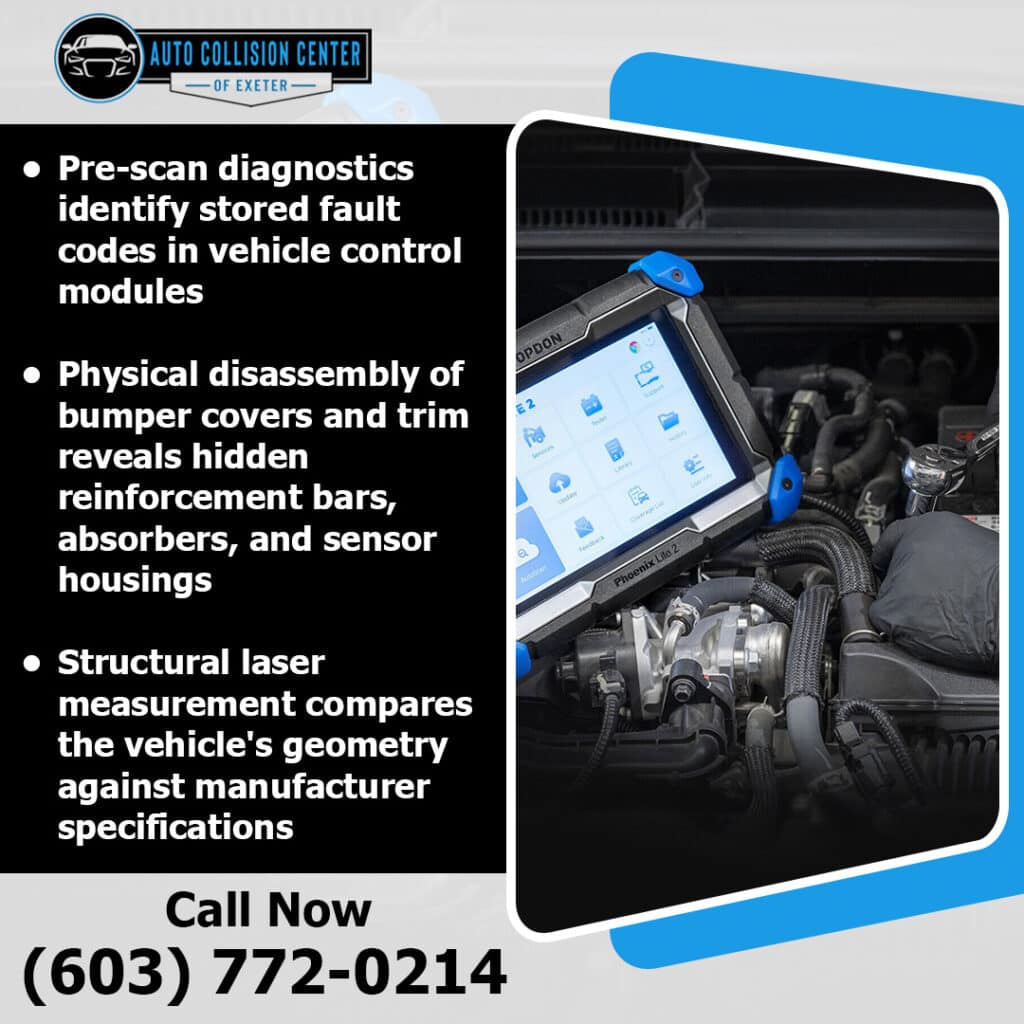
- Disassembly exposes damage you cannot see
- Laser measurements confirm structural accuracy
- ADAS evaluation flags calibration needs
- A written repair plan supports insurance approval
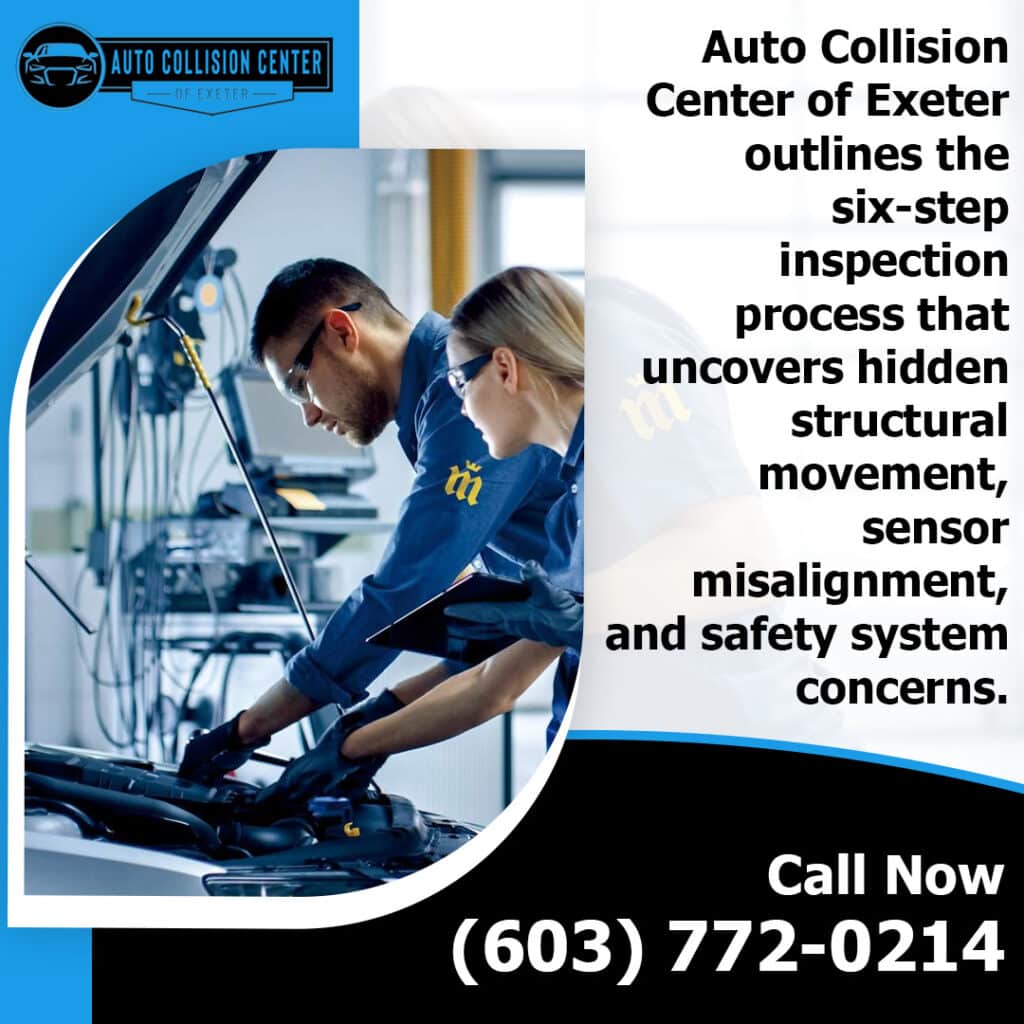
A full auto body damage inspection includes documented vehicle check-in, electronic pre-scanning, physical disassembly, laser frame measuring, safety system evaluation, and a written repair plan; all completed before a single repair begins.
Surface dents and scratched paint are what you can see. Hidden behind them are bent reinforcements, triggered safety sensors, and structural shifts that don’t show up without the right tools and procedures. Any auto body repair shop that writes estimates based on appearance alone is working with incomplete information.
If you’ve been searching for an auto body shop near you after a collision, the inspection process is the first thing to ask about. Auto Collision Center of Exeter lists each stage, what each step looks for, and why the sequence matters. This helps you to evaluate whether a shop is doing the job completely. As a family-owned collision center with 50 years of combined experience, we know the importance of a thorough inspection. Our car body repair is rooted in meticulous attention to detail, especially during the inspection phase, where hidden damage is most often revealed.
Why a Visual Estimate Falls Short of Auto Body Damage Repair
A visual estimate records what is visible: panel damage, broken lights, scraped paint. It cannot reveal what lies behind exterior surfaces.
Vehicle Construction Makes Hidden Damage Likely
Today’s vehicles use unibody construction, where the body and frame are one integrated structure. Crumple zones are engineered to absorb and distribute collision energy through frame rails, mounting brackets, and crossmembers, not just at the point of impact.
A collision at 10–15 mph can shift a structural member by a few millimeters. That shift affects steering geometry, tire wear, and crash performance in any future accident. None of it is visible from outside.
Safety Components Live Inside Panels
Radar sensors, forward cameras, and ultrasonic modules sit inside bumper assemblies, mirror housings, and windshield mounts. Wiring harnesses run along rocker panels and door sills. Impact forces can displace or sever these components without leaving a visible mark on the exterior.
| Safety Technology | Crash Reduction Impact |
| Forward Collision Warning (FCW) | ~27% fewer rear-end crashes |
| Automatic Emergency Braking (AEB) | ~50% fewer rear-end crashes |
Source: IIHS
These systems only perform as designed when sensors are undamaged and properly calibrated. A visual estimate provides no way to confirm that.
Step 1: Vehicle Check-In and Photo Documentation
The inspection process at any thorough auto body repair shop starts before a single panel is touched.
When your vehicle arrives at Auto Collision Center of Exeter, we talk with you first. We go over your situation (insurance claim or out-of-pocket payment), explain each step, and answer your questions before work begins.
Then we complete a documented check-in. We photograph your vehicle with approximately 100 images, covering every exterior panel, interior surfaces, and all areas of visible damage.
That photo record creates a verified baseline. It removes any question about which damage existed before the repair and which resulted from the collision. For insurance claims, it supports accurate, detailed documentation with your carrier. It also keeps the repair scope honest; nothing is added later that was not part of the original damage picture.
Step 2: Pre-Scan Diagnostics
What a Pre-Scan Involves
A pre-scan is an electronic diagnostic completed before disassembly begins. Using Snap-On and Hunter/Bosch scanning tools, we pull stored fault codes from your vehicle’s control modules. These codes show which systems recorded activity during the collision, even when no dashboard warning light has been activated.
The codes direct the evaluation; they tell us which systems need closer physical inspection during disassembly.
Systems the Pre-Scan Evaluates
- Airbag and supplemental restraint modules
- Anti-lock braking system (ABS)
- Blind spot monitoring
- Lane departure warning
- Adaptive cruise control
- Forward collision alert
Starting repairs without a pre-scan means starting with gaps in the damage picture. Drivers seeking thorough auto body damage repair in Exeter, NH, should confirm that pre-scanning is a standard step in any auto body repair shop’s intake process, not something performed only when a warning light is on.
Step 3: Disassembly: The Core of Any Car Body Repair
This step is where the difference between a surface estimate and a real inspection becomes clear.
Why Exterior Panels Must Come Off
Bumper covers, fender liners, and trim panels are exterior surfaces only. Behind each one are structural components: energy absorbers, steel reinforcement bars, mounting brackets, and sensor housings. A collision that barely marks the cover can crack the reinforcement behind it, bend mounting points, and rupture the foam absorber, all without showing on the outside.
Disassembling the damaged panels is the only way to see what actually happened to the underlying structure. Common findings once panels are off:
- Cracked inner reinforcement bars
- Bent or sheared mounting brackets
- Pinched or damaged wiring harness sections
- Paint separation at impact seams indicates force transfer into the structure
Structural Measurement After Disassembly
Once the damaged area is physically accessible, we measure the vehicle using Spanesi laser frame measuring equipment. This system compares your vehicle’s actual structural points against the manufacturer’s published factory specifications measured in millimeters.
The Insurance Institute for Highway Safety consistently identifies structural integrity as central to how well a vehicle protects occupants in a crash. A deviation of just 2–3 millimeters in a frame rail affects how suspension components align and how the vehicle responds in a future collision.
Car body repair that misses structural shifts because disassembly was skipped produces problems that surface months later and cost far more to correct.
Step 4: Frame and Unibody Measurement
What Frame Measuring Involves
Frame measuring uses our Spanesi computerized laser system to map your vehicle’s structural reference points against factory tolerances. Every vehicle manufacturer publishes specific dimensional specifications. Our equipment identifies where your vehicle’s actual measurements deviate from those numbers.
What Deviations Affect
Even small structural deviations carry consequences that compound over time:
- Suspension geometry: Camber and toe angles shift, causing uneven tire wear and reduced handling predictability
- Steering alignment: The vehicle pulls without driver input
- Crash energy absorption: Crumple zones that have already deformed cannot perform as designed in a subsequent collision
- Panel and door fitment: Irregular gaps and misaligned closures often signal frame movement
Restoring the vehicle to factory specification is not cosmetic work. It restores the safety performance that the vehicle was engineered and tested to deliver. Appraisers and buyers carefully review structural repair history when evaluating a vehicle’s condition and value. Documented auto body damage repair protects both your safety and your vehicle’s market value long after the repair is done.
Step 5: Safety System Evaluation and ADAS Assessment
What ADAS Means
Advanced Driver Assistance Systems (ADAS) are the electronic safety features in modern vehicles: automatic emergency braking, lane departure warning, blind spot monitoring, rear cross-traffic alert, and adaptive cruise control. These systems rely on sensors, cameras, and radar modules mounted at precise locations throughout the vehicle.
When a collision shifts these mounting points, even slightly, sensor aim is affected. The system may appear normal. No warning light activates. But detection accuracy may be reduced, with the system responding too late in a real emergency.
When Calibration Is Required
Our inspection identifies whether calibration is needed. It is typically required when:
- A front or rear bumper assembly is removed and reinstalled
- A windshield is replaced
- Structural components near sensor mounting points are repaired
- A wheel alignment follows structural correction
When calibration is required, we coordinate it through certified partners who perform the work at our facility using manufacturer-approved equipment. At our certified auto body shop in Exeter, NH, we manage the process. You are not responsible for a separate appointment or transporting your vehicle elsewhere.
Our inspection process assesses whether ADAS evaluation is needed on every vehicle, not only on those with visible sensor damage.
Step 6: Repair Plan and Insurance Coordination at a Certified Auto Body Shop in Exeter, NH
Once the inspection and disassembly are complete, we build a written repair plan. It documents every damaged component, the repair method for each, required parts, and an estimated timeline.
For insurance claims, we submit this directly to your carrier. When disassembly reveals damage beyond the original estimate, which is common, we handle the supplement process with the insurer. You do not negotiate that yourself.
At Auto Collision Center of Exeter, you receive a clear picture of what is being repaired, why it is necessary, and how long it will take before any work starts. Nothing begins without your knowledge and approval.
On cost: a detailed, inspection-based repair plan is the only honest way to price a repair. It accounts for the actual scope of damage rather than a quick visual guess. That is what affordable auto body repair looks like in practice: accurate pricing for the right scope of work, with nothing added unexpectedly after approval.
What a Completed Inspection Report Should Show You
A proper inspection produces documentation you can review. Before approving repairs, you should be able to see:
- Pre-scan report: The list of fault codes pulled from your vehicle’s modules, with notes on which systems triggered
- Photo documentation: The approximately 100 images taken at check-in, showing all pre-existing and collision-related damage
- Disassembly findings: Written or photographed record of what was found once panels were removed, including components not visible during the initial estimate
- Frame measurement data: Actual readings from your vehicle compared to factory specification, identifying deviations and corrections planned
- ADAS evaluation note: Confirmation of which systems were checked and whether calibration has been flagged
A shop that cannot produce this documentation has not completed a full auto body damage inspection. Reviewing these records before approving any car body repair puts you in control of the decision.
What Our Inspection Process Does Not Cover
Our auto body repair process is focused on late-model vehicles. It does not extend to:
- Stand-alone rust restoration projects (note: we do repair rust damage resulting from collisions)
- Classic or vintage vehicle restoration
- Custom body fabrication or modifications
- Heavy-duty or commercial vehicle repair
Every collision-related vehicle receives the full inspection process described above. We do not assess cosmetic damage separately from structural integrity. Both are evaluated together from the start.
Why I-CAR Certification Shapes the Quality of an Inspection
I-CAR Gold Class certification is not a one-time achievement. It requires ongoing training across the entire repair team as vehicle technology continues to change. Our technicians hold I-CAR Platinum certification and complete coursework each year covering new materials, structural designs, and evolving safety system configurations.
This directly affects how inspections are conducted. High-strength steel responds to impact differently depending on the vehicle’s design and model year, which is why our I-CAR-trained technicians stay current on repair procedures for each vehicle generation. ADAS sensor placement varies by trim level and manufacturer, requiring technicians to reference vehicle-specific specifications during every inspection. An inspection guided by current I-CAR training is more reliable than one based on procedures that have not kept pace with modern vehicle construction.
Bryan Dinger, our general manager, brings over a decade of industry experience, combined with formal training from the Universal Technical Institute. That depth of knowledge shapes how every inspection at our auto body repair shop is conducted.
Our 5,000 sq ft facility is equipped with Spanesi frame systems and Snap-On and Bosch diagnostic tools to support thorough structural and systems assessment at each stage of the repair process.
Why a Complete Inspection Protects Your Vehicle’s Value
A thorough inspection followed by documented auto body repair protects value in two practical ways.
Full documentation creates a paper trail. Repairs completed under OEM procedures with proper records support resale value. A repair with no inspection history raises questions for buyers and appraisers alike.
Restoring a vehicle to manufacturer specification also preserves the structural performance the vehicle was engineered to deliver in future collisions. Correct geometry maintains crash ratings, suspension function, and safety system reliability. Hidden deviations found and corrected during inspection prevent the premature tire wear, steering pull, and loose suspension components that unaddressed structural shifts eventually cause.
At Auto Collision Center of Exeter, our limited lifetime warranty covers all repairs and paint work for as long as you own your vehicle. That level of commitment is possible because we complete every phase of the inspection process on every vehicle we take in. For anyone researching auto body repair in Exeter, NH, that warranty is one of the clearest signals that a shop stands behind its work.
Schedule Complete Auto Body Damage Repair in Exeter, NH
A full auto body damage inspection is not optional for a safe, lasting result. This includes check-in documentation, pre-scan diagnostics, physical disassembly, frame measurement, ADAS evaluation, and a written repair plan—all completed before repairs begin. Every step matters.
Auto Collision Center of Exeter provides car body repair in Exeter, NH, with care and precision. We handle insurance coordination, provide regular updates throughout the repair, and back all work with a lifetime warranty. Drivers across the Seacoast choose our certified auto body shop because we treat every repair as if it belongs to one of our own.
If your vehicle has been in a collision, do not approve repairs before a complete inspection has been done. Call us at (603) 772-0214 or email accofexeter@gmail.com. We are located at 58 Winter Street in Exeter, NH, serving drivers across the New Hampshire Seacoast. Contact us to schedule your inspection.