Synopsis
Surface damage often hides deeper problems that worsen with time. Delaying auto body repairs allows structural stress, safety system misalignment, and paint failure to spread, increasing risk and repair scope. Early professional evaluation limits escalation and protects vehicle integrity.
Key Takeaways
- Minor damage often conceals structural issues
- Delays weaken safety system performance
- Paint damage accelerates metal deterioration
- Structural misalignment alters vehicle behavior
- Waiting complicates documentation and claims
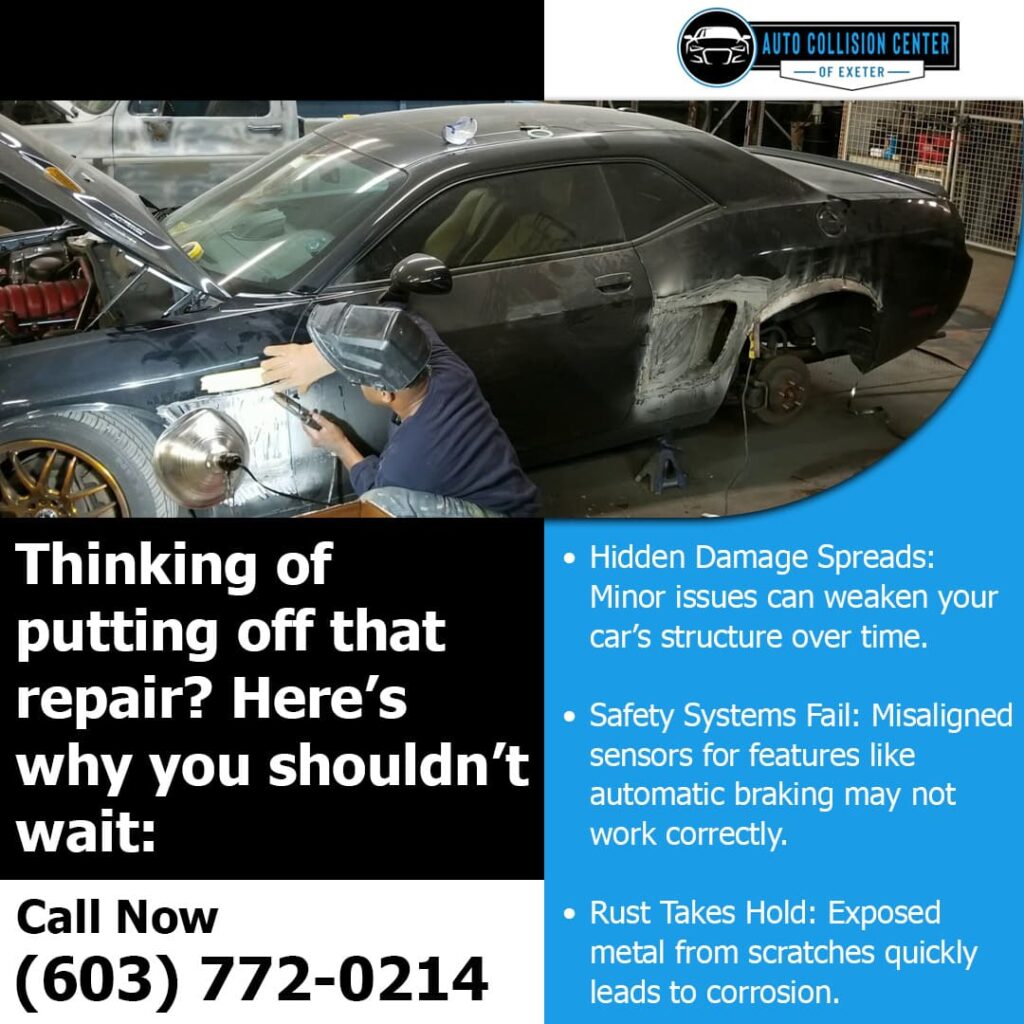
Surface damage rarely tells the complete story after a collision. What appears as a manageable dent or scrape frequently conceals structural issues that compound over time. Postponing professional repair allows these hidden problems to proliferate throughout your vehicle. This compromises both safety systems and body integrity. Modern vehicles depend on precise structural alignment to function properly and protect occupants during accidents.
Auto Collision Center of Exeter is an auto body repair shop in Exeter, NH. Our team has over fifty years of combined experience. We consistently observe how delayed attention transforms straightforward repairs into complex restoration projects requiring extensive work.
Why Even Minor Auto Body Damage Should Not Be Ignored
A small dent, damaged bumper cover, or subtle panel gap might appear insignificant. The reality differs substantially. Current vehicle engineering incorporates tight tolerances where each component fulfills specific structural or protective functions. Surface-level damage often signals deeper concerns that become apparent during professional disassembly and inspection.
New Hampshire weather patterns accelerate damage progression. Freeze-thaw cycles create expansion forces within existing cracks. Road salt compounds applied during the winter months attack exposed metal surfaces. Ordinary driving generates constant vibration that travels through compromised areas. These factors cause initial damage to spread systematically.
Minor collision impacts create effects beyond the visible contact point:
- Quarter panel deformation may indicate suspension attachment displacement
- Bumper cover fractures often accompany hidden bracket failures
- Door alignment changes can signal pillar or rocker panel distortion
- Hood fitment gaps frequently reveal radiator support displacement
The National Highway Traffic Safety Administration documents how vehicle structural soundness directly influences occupant protection during subsequent collisions. Existing damage creates structural weak points that alter force distribution patterns through the body during impact events.
Hidden Structural Damage That Gets Worse Over Time
The most serious issues develop where they cannot be observed without proper assessment tools. Contemporary vehicles employ unibody construction where exterior panels contribute to overall structural strength. Damage sustained anywhere within this integrated framework affects the complete vehicle system. We encounter this pattern regularly at our certified auto body shop in Exeter, NH, when customers arrive months after their initial accidents.
How Unibody and Frame Components Are Affected
Modern unibody design integrates body panels, floor assemblies, and roof pillars into one structural assembly. This engineering approach distributes collision forces throughout the vehicle to safeguard occupants. When any section sustains impact damage, stress accumulates at junction points instead of dispersing uniformly across the structure.
Compromised areas generate flex zones that should not exist within proper vehicle geometry. Repeated loading cycles produce metal fatigue at these critical locations. Minor cracks extend through welds and seam connections. Initially, repairable damage transforms into replacement requirements as base material integrity deteriorates progressively. We use Spanesi frame measuring systems to detect these hidden structural problems during comprehensive assessments.
Why Driving With Structural Damage Changes Vehicle Behavior
Frame misalignment generates observable handling characteristics. Steering drift occurs when opposing sides sit at different heights. Tire wear patterns become uneven as suspension angles deviate from manufacturer specifications. Doors may fail to latch securely as frame sections deform under normal loading conditions.
Compromised crash protection represents the most serious concern. NHTSA research shows compromised vehicle structures increase occupant injury severity through greater compartment intrusion in crashes. Pre-existing damage alters how collision forces transfer through the body structure.
Safety Systems Do Not Work Correctly When Repairs Are Delayed
Current vehicles incorporate numerous sensors and camera systems within body panels and bumper assemblies. These technologies require exact positioning to operate according to design specifications. Physical damage displaces mounting locations. This generates alignment discrepancies that degrade system performance in ways that jeopardize your protection.
Sensors, Cameras, and Mounting Points Depend on Body Alignment
Forward collision detection systems operate within narrow positional tolerances. Bumper displacement measuring only millimeters shifts the detection field substantially. This potentially produces missed warnings or false activations. Blind spot monitoring cameras demand precise positioning relative to mirror housings and body contours.
Critical sensor locations affected by collision damage include:
- Radar assemblies positioned behind bumper covers requiring clear signal paths
- Lane tracking cameras measuring road position relative to vehicle centerline
- Distance sensors mounted in bumper corners calculating proximity to obstacles
- Adaptive cruise modules integrated within front grille assemblies
We coordinate professional ADAS recalibration through certified technician partners at our auto body repair shop after completing structural repairs to restore these systems to factory operational specifications.
Why Improper Alignment Leads to Inaccurate Safety Responses
Systems calibrated to undamaged vehicle dimensions generate faulty data when structural positioning changes. Automatic emergency braking may engage late or fail. Adaptive cruise functions could maintain incorrect following intervals. Distance sensors may produce false proximity indications that drivers eventually disregard.
These operational failures do not consistently activate dashboard warning indicators. The system continues operating while using corrupted input information. Motorists depending on these features for accident avoidance face elevated risk without recognizing that their protective systems have become unreliable.
Paint Damage Leads to Deterioration and Long-Term Body Failure
Automotive paint coatings serve protective functions beyond visual appearance. They provide primary environmental barriers protecting metal substrates from moisture and oxygen exposure. Chips, scratches, and coating breaches expose bare metal to atmospheric elements. This exposure initiates surface deterioration that propagates beneath adjacent intact coatings.
Surface oxidation begins within hours following exposure. Moisture infiltration extends underneath the surrounding paint layers. This generates blistering and coating separation. New Hampshire winter road treatment programs accelerate these degradation processes substantially. Panel joints and weld locations demonstrate particular vulnerability to moisture intrusion.
Water penetration extends into enclosed body cavities where visual detection becomes impractical. Surface deterioration compromises structural joints and connections. This diminishes overall body strength systematically. What initiates as superficial coating damage progresses into structural degradation. Component replacement becomes necessary rather than simple, affordable auto body repair interventions.
Delayed Repairs Often Lead to More Extensive Repairs Later
Damage amenable to straightening procedures when fresh becomes irreparable following weeks or months of stress cycling. Metal hardens at deformation locations through repeated flexing. Continued vehicle operation generates fatigue fractures that extend from the original impact zones. What begins as an affordable auto body repair escalates into major reconstruction requiring substantial investment.
When Repairable Panels Become Replacement Candidates
Sheet metal retains formability immediately following impact events. We restore original contours through controlled repair procedures at our auto body repair shop when damage receives prompt attention. Time and ongoing use eliminate this material plasticity. Metal becomes brittle at concentrated stress points. It fractures during attempted repair operations.
Deformation expansion affects neighboring panel sections. Fender damage extends into the door structures. Quarter panel distortion influences wheel housings and rocker assemblies. Originally isolated damage evolves into multi-component involvement requiring additional parts and increased labor investment.
How Secondary Damage Develops Over Time
Normal vehicle operation transmits constant vibration through damaged structural areas. Attachment brackets gradually loosen. Connection points elongate through repeated loading. Panel spacing widens as fastening hardware works free from mounting locations. These cascading failures amplify the original damage significantly. They generate extensive repair requirement lists.
Loading stress transfers to adjacent stronger components when damaged sections flex abnormally. Door hinge assemblies wear prematurely. Liftgate support struts fail before expected service life. Suspension bushings tear from misaligned force vectors. By addressing initial damage through prompt car body repair in Exeter, NH, we prevent these subsequent component failures.
Insurance and Documentation Challenges Caused by Waiting
Insurance coverage ties directly to documented incident details. Recent damage accompanied by photographic evidence and written reports establishes clear cause relationships. Waiting introduces uncertainty regarding the origins and extent of damage. This complicates claims administration at any auto body shop.
Environmental exposure and additional vehicle operation between incident occurrence and claim filing complicate damage assessment. Evaluators face difficult questions:
- Did deterioration exist during the accident or develop subsequently?
- Does structural misalignment stem from collision forces or continued driving?
- Which damaged components connect to the covered incident versus normal vehicle aging?
These ambiguities complicate approval decisions and settlement determinations.
Documentation deficiencies impair claims processing efficiency. Original photographs may not capture the complete damage scope. Absent inspection documentation raises questions about concealed issues.
Professional assessment immediately following accidents establishes baseline damage documentation. We complete over 100 photographs during initial inspections to support your insurance claims. Waiting until problems intensify reduces your capacity to demonstrate that all repair requirements stem from covered collision events.
Why Certified Auto Body Shops Address Problems Early
Certified repair operations follow manufacturer-published procedures for damage evaluation and correction. I-CAR Gold Class facilities like ours maintain training requirements covering contemporary vehicle construction and repair methodologies. This specialized knowledge enables us to identify damage that non-certified operations might overlook during assessment at our certified auto body shop in Exeter, NH.
Evaluation Before Repair Prevents Missed Damage
Professional inspection protocols include disassembly of affected areas. Apparently isolated damage frequently indicates more extensive underlying problems. We document complete findings before generating repair estimates. This approach eliminates mid-project surprise discoveries that delay completion and increase costs.
Visual assessment reveals apparent damage characteristics. Computerized measurement verification using laser dimensional systems detects frame and unibody misalignment invisible through visual inspection alone. We employ Spanesi frame measuring equipment for precision alignment verification during assessment. This methodology captures concealed damage that intensifies when left unaddressed.
Repair Planning Based on Manufacturer Procedures
Vehicle manufacturers publish detailed repair procedures for every model produced. These technical guidelines specify required materials, application techniques, and process sequences that restore original safety performance characteristics. We access and implement these documented procedures rather than developing improvised repair approaches.
Original equipment manufacturer guidelines address welding specifications, structural adhesive application requirements, and component replacement criteria. Sequential procedures detail proper disassembly, repair execution, and reassembly processes. Adherence to these published standards protects vehicle structural integrity and occupant safety features.
When It Is Especially Risky to Delay Auto Body Repairs
Specific damage categories generate immediate safety concerns that intensify rapidly. Front or rear impact damage frequently affects engineered crumple zones designed to absorb and dissipate collision energy. Compromising these protective structures diminishes occupant protection during any subsequent accident involvement.
Damage proximate to wheel assemblies or suspension mounting affects directional stability and handling predictability. Misaligned suspension geometry produces unpredictable steering responses and degraded braking performance. These conditions elevate accident risk substantially beyond the consequences of original damage alone.
Vehicles equipped with advanced driver assistance systems demand immediate professional evaluation at a reliable auto body repair shop following any collision involvement. Sensor and camera displacement render these safety features unreliable without proper structural repair and system recalibration. Continuing operation while depending on compromised assistance systems generates dangerous false security perceptions.
| Damage Location | Potential Consequence | Risk Timeline |
| Front bumper/grille | Forward collision warning malfunction | Immediate |
| Quarter panel | Blind spot monitoring inaccuracy | 1-2 weeks |
| Door/pillar | Side impact protection reduction | Progressive |
| Rear bumper | Parking sensor errors | Immediate |
| Undercarriage | Paint exposure leading to body deterioration | 3-6 months |
How Prompt Auto Body Repair Helps Protect Vehicle Value
Professionally documented repairs preserve vehicle value more effectively than visible unrepaired damage. Prospective buyers and dealers apply value reductions to vehicles displaying obvious collision history. Proper auto body repair eliminates visual evidence while establishing service records demonstrating professional restoration completed to proper standards.
Structural integrity preservation maintains long-term operational reliability. Vehicles receiving appropriate damage repair perform almost identically to undamaged examples throughout their service life. Repair postponement permits degradation affecting mechanical systems and necessitating additional corrective work subsequently.
Appropriate component fit and surface finish indicate quality workmanship standards:
- Panel gaps matching factory specifications signal professional repair execution
- Consistent paint appearance across adjacent surfaces demonstrates proper refinishing technique
- Correctly aligned closure panels indicate accurate structural restoration
- Smooth surface contours without distortion waves reflect skilled metalwork
These observable quality indicators significantly influence resale valuations. Paint mismatches or inadequate body alignment suggest inferior workmanship or deferred maintenance that buyers identify immediately during vehicle inspection.
What To Do If You Have Been Driving With Unrepaired Damage
Do not assume observable damage represents the complete problem scope. Contemporary vehicle construction conceals structural issues behind apparently intact exterior panels. Professional evaluation reveals the extent of damage affecting both safety and operational performance.
Schedule an assessment at a certified auto body shop in Exeter, NH, like Auto Collision Center of Exeter. We conduct a complete disassembly of affected areas and measure structural alignment against manufacturer specifications. This inspection documents all conditions requiring correction, from visible surface damage to concealed frame displacement.
Inquire about inspection procedures and documentation protocols:
- Request photographic documentation of all identified damage
- Confirm that diagnostic scanning will detect concealed system malfunctions
- Verify that dimensional measurements will be recorded and compared against specifications
We perform thorough pre-repair evaluations, including over 100 photographs documenting the complete vehicle condition. This extensive documentation protects your interests and provides supporting evidence for insurance claim submissions.
Why Exeter Drivers Trust Professional Auto Body Repair at Auto Collision Center of Exeter
Family-owned operations invest in community relationships depending on quality workmanship and transparent communication practices. At Auto Collision Center of Exeter, we established our reputation by prioritizing correct repair procedures over expedient shortcuts. This operational philosophy delivers lasting results, protecting both safety and asset value.
Bryan Dinger, our general manager, brings more than twenty years of auto collision repair experience, combined with Universal Technical Institute training, to our work. This direct leadership involvement maintains consistent quality standards and technical precision across all customer work.
We recognize that prompt professional car body repair in Exeter, NH, protects both your financial investment and personal safety. Our I-CAR Gold Class certification and manufacturer-approved equipment enable us to deliver factory-specification restoration quality.
We perform collision repair, frame straightening, auto body repair, and paint refinishing within our 5,000-square-foot facility. For specialized services, including ADAS recalibration and glass replacement, we coordinate with certified partner technicians meeting our quality requirements.
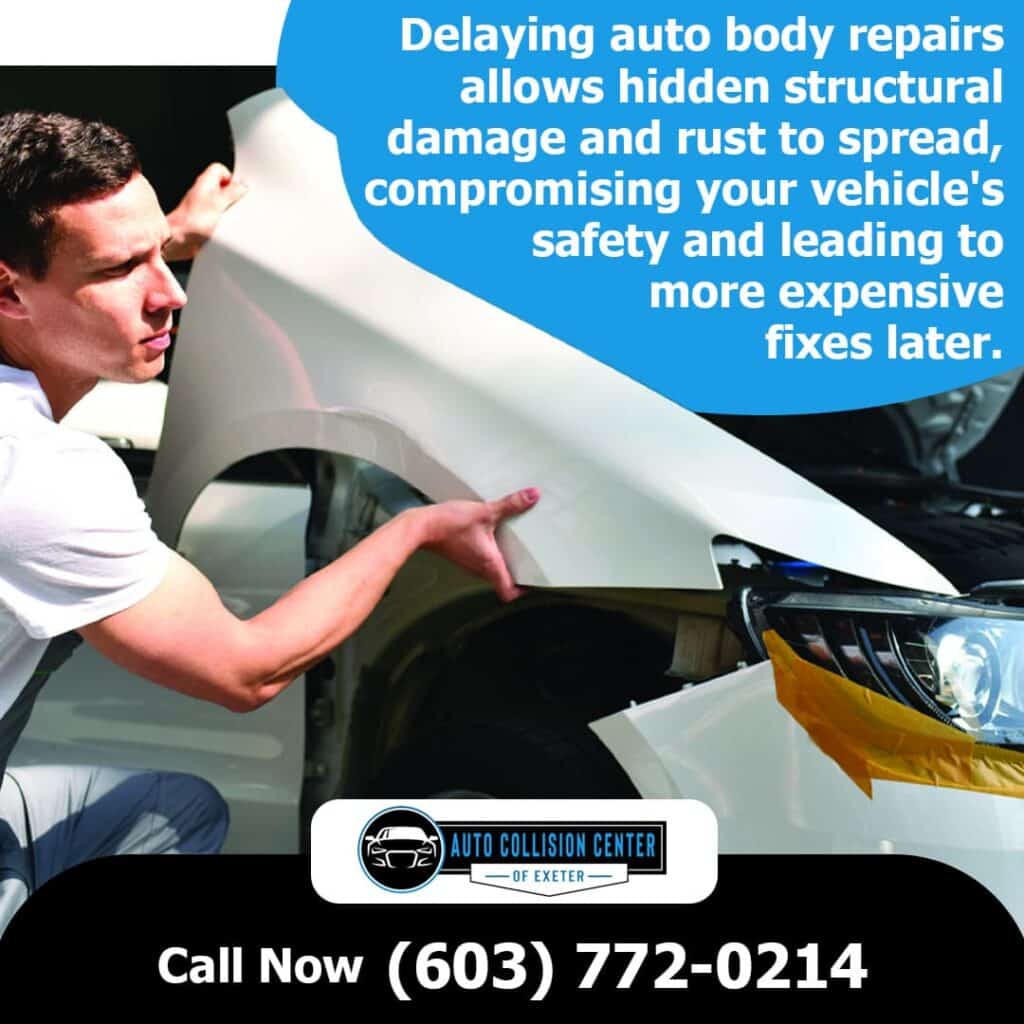
Delaying Auto Body Repairs Creates Risks That Grow Over Time
Minor visible damage conceals significant problems that compound continuously. Structural misalignment, safety system degradation, and paint barrier failure progress silently beneath superficial damage appearances. Immediate professional evaluation protects your personal safety while preserving vehicle asset value. It prevents manageable repair situations from evolving into extensive reconstruction projects requiring major investment.
Contact Auto Collision Center of Exeter at (603) 772-0214 or accofexeter@gmail.com when you are looking for an auto body shop near you in Exeter, NH. Our experienced team delivers detailed damage evaluation and proper restoration work. We address existing conditions while preventing future deterioration. Schedule your vehicle inspection today to protect both your automobile and your family’s safety.