Synopsis
Winter collisions often damage vehicle safety systems in ways drivers cannot see. Proper diagnostic scanning and certified collision repair play a direct role in restoring these systems to safe, factory-intended operation after winter accidents.
Key Takeaways
- Winter impacts alter crash dynamics, making safety systems more vulnerable than in dry-road collisions.
- Low-speed winter accidents can disable sensors and restraints without visible body damage.
- ADAS, ABS, airbags, and seatbelt pretensioners are commonly affected during icy-road crashes.
- Visual inspections alone cannot detect electronic safety system failures after winter collisions.
- Diagnostic scanning before and after collision repair is an industry best practice and is recommended by many vehicle manufacturers to verify safety system status and detect any hidden faults.
- Certified collision repair following OEM procedures supports long-term vehicle safety and value.
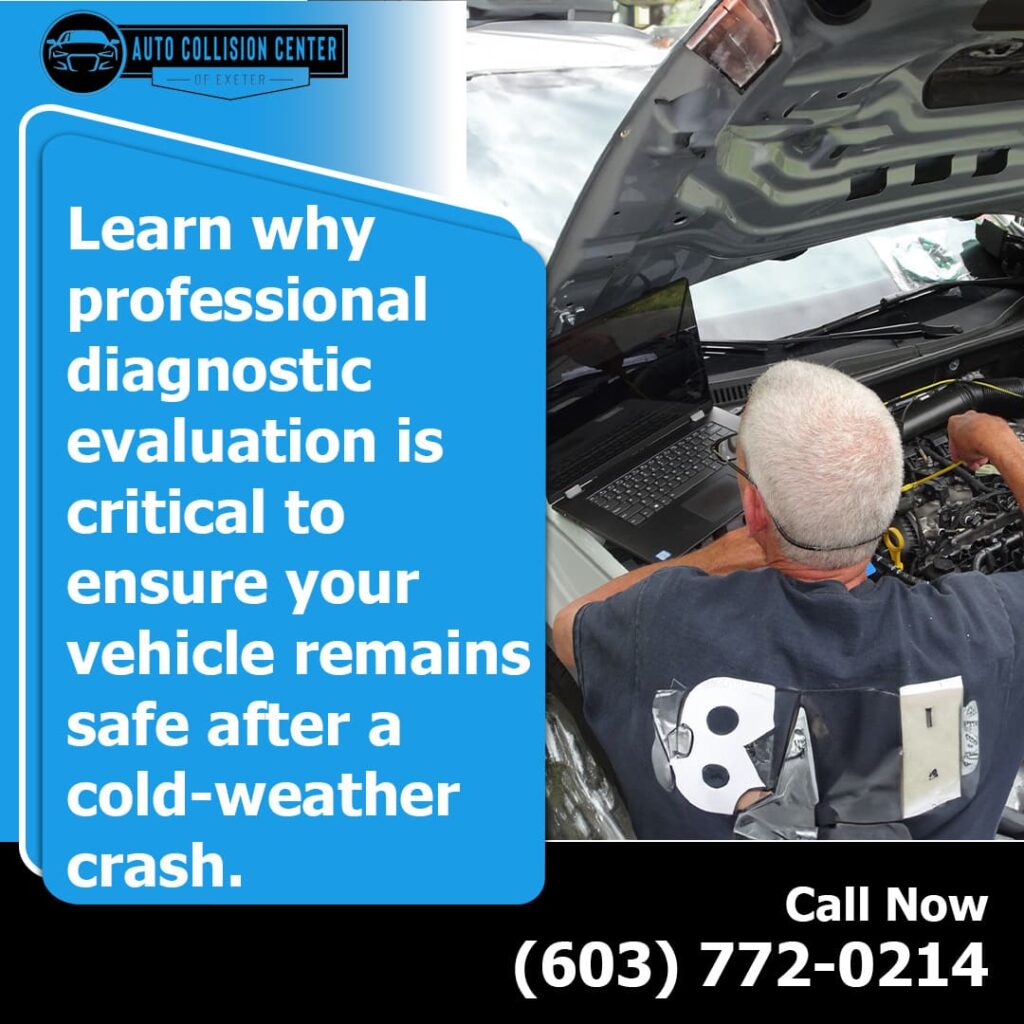
Winter accidents damage vehicle safety systems more frequently than many drivers expect. When your vehicle slides on icy roads, the impact dynamics differ from summer crashes, frequently harming sensors, airbag components, and electronic controls, even in apparently minor accidents.
At Auto Collision Center of Exeter, we’ve seen how New Hampshire winters create distinct challenges for our neighbors. With over 50 years of combined experience and I-CAR Gold Class certified collision repair, our team understands exactly how winter collisions compromise these critical systems. We’ve helped countless Exeter families restore not just their vehicles’ appearance, but the hidden safety technology that protects them on Route 101 and Hampton Road.
Why Winter Collisions Impact Vehicle Safety Systems Differently
With our experience in winter collision repair in Exeter, we’ve learned that ice and snow fundamentally alter how vehicles absorb impact energy. In very cold temperatures, some materials can exhibit increased stiffness or reduced flexibility. Components such as plastic housings may be more susceptible to cracking under impact depending on the specific materials and design. Reduced tire traction means impacts occur at different angles, creating collision scenarios that specifically target electronic safety systems.
How Ice and Snow Change Impact Forces
Sliding impacts distribute force differently across your vehicle’s frame. When tires lose road grip, your entire vehicle moves as a single unit. This sliding motion frequently damages sensors mounted low on the vehicle frame, particularly wheel speed sensors and radar units behind bumper covers.
Side-angle crashes occur more frequently on icy roads. These rotational forces affect door-mounted sensors, side airbag systems, and seatbelt pretensioners in distinct ways.
Why Low-Speed Winter Crashes Trigger Safety Failures
Sudden deceleration activates safety systems regardless of vehicle speed. A 15 mph slide into a snowbank can trigger the same crash sensors as a 30 mph summer collision. The deceleration rate determines sensor activation more than velocity.
Sensor misalignment may occur without visible body damage. A minor winter bump can shift a radar sensor by millimeters, disabling automatic emergency braking or lane departure warnings. The bumper cover appears fine, but the technology behind it no longer operates correctly.
The Most Common Vehicle Safety Systems Affected in Winter Collisions
Auto Collision Center of Exeter uses Snap-On and Hunter/Bosch diagnostic equipment to identify which systems sustained damage. Winter accidents frequently affect several systems simultaneously, creating cascading failures that our scans reveal.
Airbags and Crash Sensors
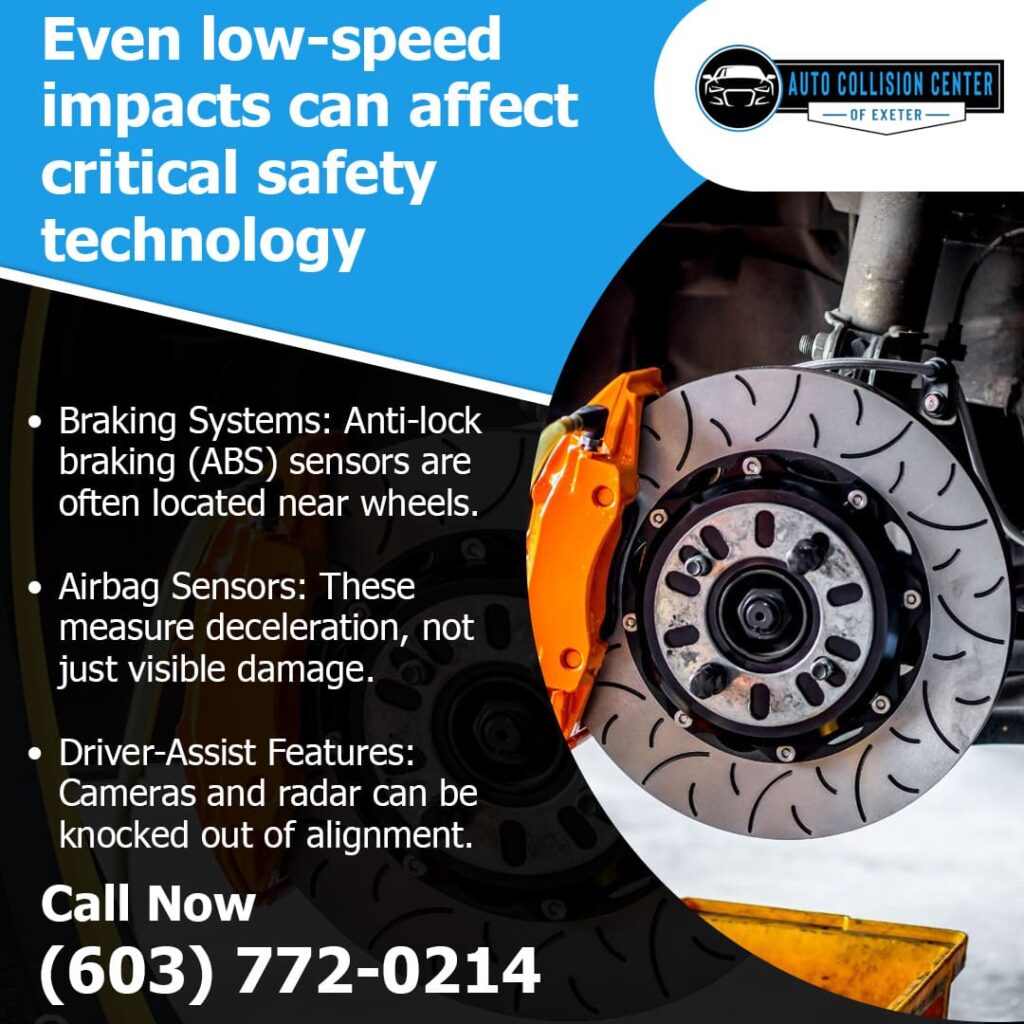
Impact sensors positioned throughout your vehicle’s frame determine when airbags deploy. These accelerometers measure deceleration forces in milliseconds. Winter accidents damage these sensors through physical impact that breaks sensor housings or electrical disruption from moisture infiltration through damaged seals.
Crash sensors and ADAS components sit behind body panels and bumper covers. Even if exterior damage looks minimal, sensors can sustain damage or calibration shifts that may not be visible without inspection and diagnostic scanning. Side impact sensors integrate into door structures and B-pillars, areas that frequently sustain damage during rotational crashes common on icy roads. We identify these failures through comprehensive diagnostic scanning before beginning repairs.
Anti-Lock Braking System (ABS) and Electronic Stability Control
Wheel speed sensors track individual tire rotation to prevent wheel lockup during braking. These sensors mount near each wheel hub, where road salt, ice, and winter debris cause maximum damage. A winter accident that impacts a wheel assembly frequently destroys or misaligns these sensors.
If wheel speed sensors fail, the ABS and stability control systems may become unavailable or operate with degraded performance, usually indicated by warning lights. Drivers may notice ABS warning lights after winter accidents, even when the brakes themselves work normally. Our car collision repair includes diagnostic scans that pinpoint exactly which sensors need replacement.
Advanced Driver Assistance Systems (ADAS)
ADAS technology relies on cameras, radar, and ultrasonic sensors mounted around your vehicle’s exterior. These systems deliver lane departure warnings, automatic emergency braking, blind-spot monitoring, and adaptive cruise control. Winter accidents damage ADAS components more frequently than any other safety technology because sensors are mounted in vulnerable locations: behind bumper covers, inside windshields, and within side mirror housings.
Vehicles with automatic emergency braking (AEB) and forward collision warning (FCW) cut rear-end crashes by half, according to the NHTSA-hosted Partnership for Analytics Research in Traffic Safety (PARTS). This protection depends on properly operating sensors.
After winter accidents, recalibration proves critical because millimeter-level accuracy determines whether these systems operate correctly. We coordinate ADAS recalibration through certified partners who use manufacturer-specific equipment to restore the precision these systems demand.
| Safety System | Common Winter Damage | Repair Requirement |
| ADAS Cameras | Windshield damage, mounting bracket shifts | Replacement and recalibration through certified partners |
| Radar Sensors | Bumper impact, ice, or snow buildup damage | Replacement and recalibration through certified partners |
| Ultrasonic Sensors | Side or rear impact, moisture infiltration | Replacement and system reset |
Seatbelt Pretensioners
Seatbelt pretensioners tighten restraints milliseconds before airbag deployment. These one-time-use pyrotechnic devices cannot be reset or reused after activation. Our diagnostic scans after winter accidents frequently reveal pretensioner codes even when airbags didn’t deploy, indicating the system detected impact forces requiring component replacement.
Hidden Safety System Damage After a Winter Accident
Visual inspection cannot identify electronic system failures. Modern vehicles conceal safety technology behind plastic covers and within structural components. A vehicle that appears fine after sliding into a snowbank may have multiple disabled safety systems.
No visible damage does not equal safety issues. Body panels can appear undamaged while sensors underneath suffer misalignment or electrical faults. Bumper covers flex during impact, protecting the exterior finish while crushing radar and camera units mounted behind them.
The Role of Diagnostic Scans
Pre-repair and post-repair diagnostic scans document safety system status. Modern vehicles store fault codes that identify which sensors detected impact forces and which systems disabled themselves for safety. Without diagnostic scanning, these problems remain hidden until the next accident. NHTSA stresses that collision repairs often require advanced diagnostics to detect structural and mechanical damage beyond visual inspection.
We run pre-scans and post-scans on every vehicle using our Snap-On scanner and Hunter/Bosch systems. Fault codes include airbag warnings, ABS sensor failures, ADAS calibration errors, and restraint system faults. We use this data to coordinate proper certified collision repair and restore your vehicle to pre-accident safety standards.
How Certified Collision Repair Protects Vehicle Safety Systems
Certified collision repair shops like Auto Collision Center of Exeter follow manufacturer procedures that protect electronic safety systems. We perform structural and body repairs in-house while coordinating specialized services like ADAS recalibration through certified partners. Our team provides complete repairs that meet all manufacturer safety requirements.
OEM Repair Procedures and Safety System Integrity
Manufacturer repair standards specify exact methods for restoring vehicles to original safety specifications. ADAS cameras and radar units work within millimeter tolerances. Frame straightening that appears visually correct may leave sensor mounting points misaligned enough to disable collision avoidance systems.
We use our Spanesi frame rack and measuring system to verify alignment meets manufacturer specifications. Every frame repair we complete at our 5,000 square foot facility follows OEM procedures exactly.
Why Technician Training Matters
Modern vehicle complexity demands ongoing technician education. I-CAR training programs provide knowledge about vehicle technology and safety system requirements. Our I-CAR Gold Class certified collision repair team stays current on the latest repair techniques.
Bryan Dinger, our general manager, brings more than twenty years of collision repair experience and training from Universal Technical Institute. This expertise guides our collision repair services in Exeter, NH, that prioritize safety system integrity. Our safety-focused philosophy means never compromising system function to reduce costs. Components designed for single-use get replaced, not reset.
What Drivers Should Do After a Winter Collision
We see the results of New Hampshire winters daily at our Winter Street location. If you’ve been in a winter accident, don’t wait for problems to appear. Schedule a diagnostic evaluation even if your vehicle looks fine.
Signs Your Safety Systems Need Evaluation
Dashboard warning lights indicate safety system faults demanding professional diagnosis. Common post-accident warnings include airbag lights, ABS indicators, traction control messages, and ADAS system alerts.
Changes in braking feel suggest ABS or stability control damage. ADAS alerts appearing after impact indicate sensor damage or misalignment. Lane departure warnings that activate incorrectly or blind-spot monitoring that fails to detect vehicles all suggest accident damage needing attention.
Why Prompt Repair Supports Long-Term Safety
Damaged sensors exposed to winter weather deteriorate faster than protected components. Moisture infiltration corrodes electrical connections. Maintaining your vehicle’s resale value demands documented repairs from certified collision repair services.
Buyers increasingly request diagnostic reports confirming ADAS and airbag system function. Vehicles with unrepaired accident damage lose value compared to those with proper auto collision repair in Exeter, NH.
Insurance and Affordable Collision Repair
We work with all major insurance companies, including our direct repair partners State Farm, Geico, and Amica. We handle 85% of our repairs through insurance claims, helping you secure affordable collision repair without unnecessary out-of-pocket expenses.
Some adjusters initially authorize only visible repairs. We document all safety system damage through diagnostic reports and manufacturer repair procedures, delivering your insurance company the technical justification needed for complete claims approval. We advocate for the repairs your vehicle truly needs.
Safety systems should not be skipped to reduce costs. Our documentation protects you by establishing that all work meets manufacturer safety standards.
Protecting Your Safety After Winter Collisions
Winter accidents affect vehicle safety systems in ways most drivers cannot see. Ice and snow create accident scenarios that specifically target sensors, cameras, and control modules positioned around your vehicle’s exterior.
Our diagnostic scanning, proper repair procedures, and coordination with certified ADAS calibration partners restore the protection automakers engineered into every vehicle. Skipping these steps leaves families vulnerable when safety systems fail during future accidents.
We opened the Auto Collision Center of Exeter in January 2023 to bring proper collision repair services to the Seacoast community. Our team combines technical expertise with transparent communication. We help you understand both the damage your vehicle sustained and the repairs needed to restore full safety system function.
If your vehicle experienced a winter accident in Exeter, North Hampton, Portsmouth, or surrounding areas, contact us at (603) 772-0214 or accofexeter@gmail.com. We back all our work with a limited lifetime warranty for as long as you own your vehicle. Our car collision repair protects what matters most: your safety and your family’s well-being on New Hampshire roads.